General Information
Species Name: Dipsacus fullonum
Also Known As: teasel, wild teasel, Fuller's teasel
Family: Dipsacaceae (Teasel)
Growth Form: Forb
Life Span: Biennial
Flowering Dates: July-September
Origin: Europe
Toxic: No
Noxious: Yes. Common teasel is listed as a County Designated Noxious Weed for Lancaster, Pawnee, and Saline County. Please report to the local weed control authority if found in the following counties: Lancaster, Pawnee, and/or Saline.
Why Is It Invasive?
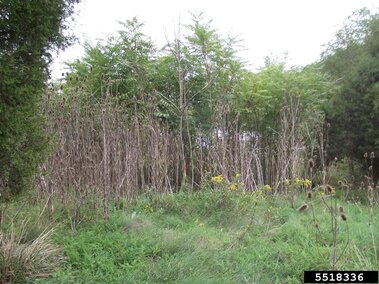
Teasel can create large, dense stands and is a highly competitive plant in open, grassy habitats. Common teasel has a negative impact on pastureland, hay fields and other agricultural fields. Teasel can overwhelm native grassland species.
What Does It Look Like?
General Characteristics
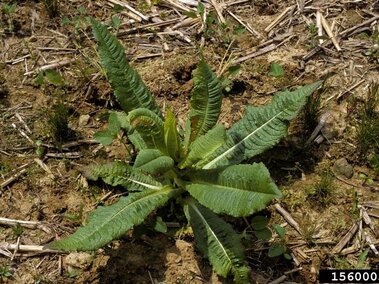
Common teasel is a taprooted, monocarpic plant that grows as a biennial or short-lived perennial that dies after it flowers. They develop a stout, fleshy taproot in the rosette stage that can be more than 2 feet long and 1 inch in diameter at the crown.
Flowers
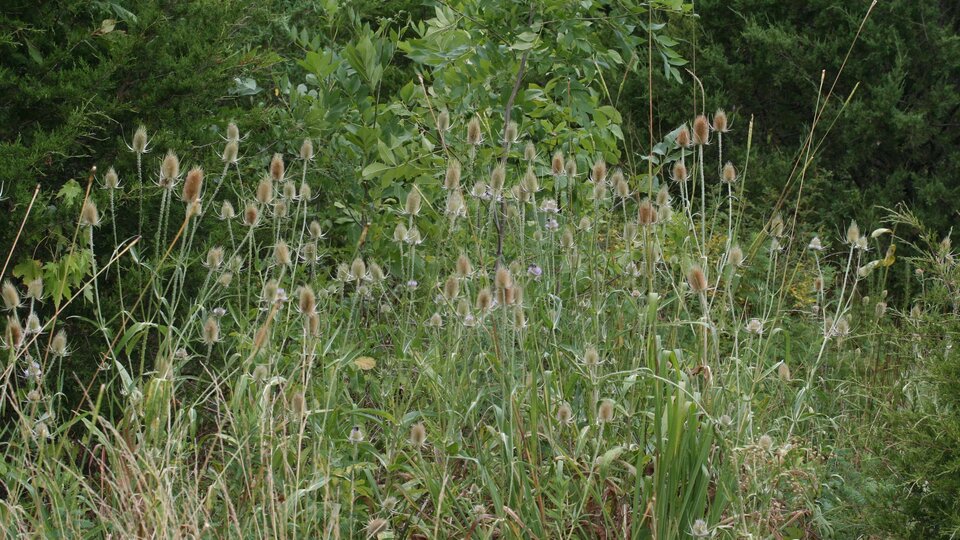
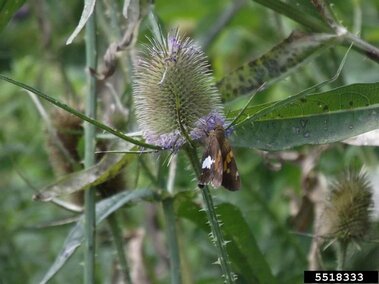
Hundreds of tiny flowers clustered in dense, egg-shaped heads. Stiff, spiny, leaf-like bracts curve up from the base of the flower head. Common teasel has purple flowers and bracts longer than the flower heads
Leaves
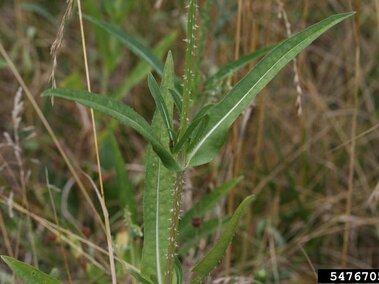
Opposite, large (up to 1.5' long), oblong, and prickly. Leaves of flowering plants join into a cup around the stem. Typical teasel leaves are not lobed.
Stems
The second year flower stems grow 0.5-2 meters tall, are striate-angled and increasingly prickly going upward. Stems are pithy or hollow and have opposite branching.
Seeds
Each plant can produce as many as 2,000 seeds. Seeds remain viable in the soil for at least two years.
Photos


Where Does It Grow?
Common teasel grows in garden areas, along creeks, pond edges, roadsides, abandoned fields and other disturbed sites. It is also grows into agricultural areas, fallow fields, pasture lands and hay meadows. It prefers open, sunny habitats and can survive in a range of wet to dry conditions.
How Does It Spread?
It was introduced to the United States in the 1700s. Like its close relative cutleaf teasel, it was used in the textile industry to raise the nap on woolen cloth and as an ornamental in gardens and floral arrangements. It escaped cultivation and has since spread throughout the United States.
Teasels are prolific seed producers with most seed falling near the parent plant. The result is expansion of existing infestations. Long range dispersal starting new infestations can occur by a variety of means. Seed can float along riparian corridors, drift with the snow, journey along transportation corridors and recreational trails from seed shed from soil on tires and vehicle undercarriages. It can also be spread on mowing equipment. Teasel has been noted in or near graveyards, spread by seed from dried floral arrangements. Birds can consume, then distribute teasel seeds.
How Do I Control It?
Mechanical
Infestation sites will need to be monitored and treated repeatedly until the seedbanks are depleted. Teasel seedbanks remain viable for a relatively short time, 3-5 years. With diligent control, eradication may be feasible within this time frame.
Hand-pulling and digging are management options for small infestations, but the large, fleshy taproots are difficult to remove. Flowers and seedheads will need to be bagged and disposed of.
Frequent mowing throughout the growing season that prevents flowering can deplete food reserves in the taproots and reduce stands over time. It is important to monitor the site and ensure that plants do not flower on short stalks. Also remove any stalks that were flattened, but not cut by the mower.
Contact your county weed control authority to determine appropriate removal methods.
Cultural
When buying hay or forage, check to make sure it is weed-free certified. Management should include proper grazing and rotational grazing techniques that would maintain rangelands and prevent invasion. Disturbed areas should be re-seeded with desirable species to prevent spread.
One way that invasive plant seeds and fragments can spread is in soil. Sometimes plants are planted purposefully. You can prevent the spread of invasive plants.
PlayCleanGo: Stop Invasive Species in Your Tracks
REMOVE plants, animals and mud from boots, gear, pets and vehicles.
CLEAN your gear before entering and leaving the recreation site.
STAY on designated roads and trails.
PLANT non-invasive species.
Chemical
Please refer to the 2025 Guide for Weed, Disease and Insect Management in Nebraska or contact your county weed control authority.
What Should I Do If I See It in Nebraska?
If you see common teasel in Nebraska, you should report it to your county weed control authority. For guidance on what information to include in your report, check out our reporting tips.
References and More Information
Center for Invasive Species and Ecosystem Health
Minnesota Department of Agriculture
National Invasive Species Information Center
Nebraska County Designated Noxious Weeds
Nebraska Department of Agriculture
Nebraska Weed Control Association
Nebraska Weed Free Forage Program
Stubbendieck, J., Coffin, M., & Dunn, C. (2019). Weeds of the Great Plains. Nebraska Department of Agriculture.