General Information
Species Name: Verbascum thapsus
Also Known As: flannel leaf, feltwort, Jacob's staff, woolly mullein, velvetplant, velvet dock, flannelplant, big taper
Family: Scrophulariaceae (Figwort)
Growth Form: Forb
Life Span: Biennial
Flowering Dates: June-July
Origin: Eurasia, Africa
Toxic: No
Noxious: Yes. Common mullein is listed as a County Designated Noxious Weed for Banner and Cheyenne County. Please report to the local weed control authority if found.
Why Is It Invasive?
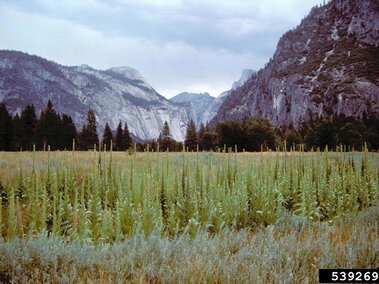
Once established, common mullein grows quickly to form a dense ground cover. It can overtake and displace native species. At the high densities, it appears to prevent establishment of native herbs and grasses following fires or other disturbances.
What Does It Look Like?
General Characteristics
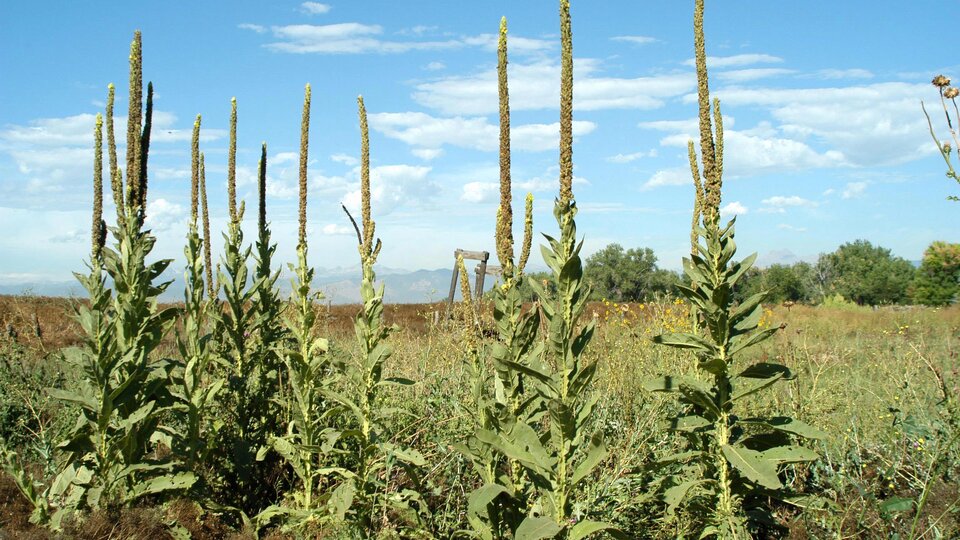
Common mullein does not have branches and can grow up to 6.6 ft (2 m) tall. The plant has a deep taproot along with a fibrous root system. Vernalization (exposure to cold temperatures) is required to induce flowering the following spring.
Flowers
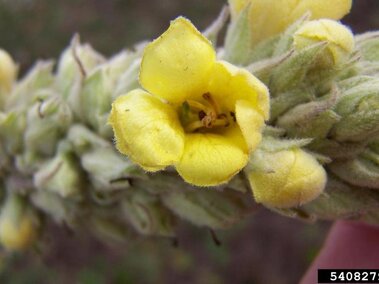
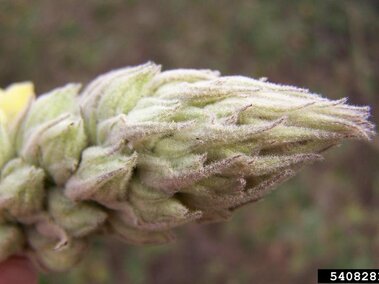
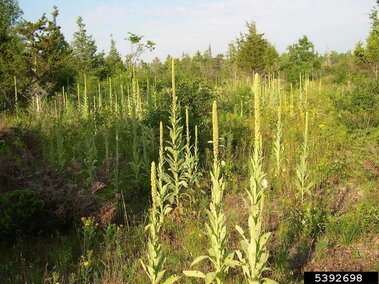
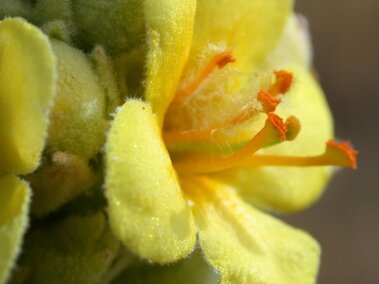
In the second year, common mullein produces a very noticeable flower stalk 5 or more feet tall. The inflorescence is a spike-like raceme, usually singular, but sometimes branched, with alternating leaves on the flower stalk decreasing in size toward the top. The stalk’s growth is indeterminate, and the length of the flowering period is related to stalk height, with taller stalks blooming longer. Small yellow (rarely white), 5-petaled flowers are grouped densely on the leafy spike and bloom a few at a time throughout the summer, maturing on the stalk from the bottom to the top in successive spirals. Each individual flower opens before dawn and closes by mid-afternoon. Flowers attract a wide variety of insects, including bees, flies, butterflies and other insects; but only short- and long-tongued bees are effective in cross‑pollination. Flowers are also autogamous, so self-pollination occurs at the end of the day on flowers not cross‑pollinated.
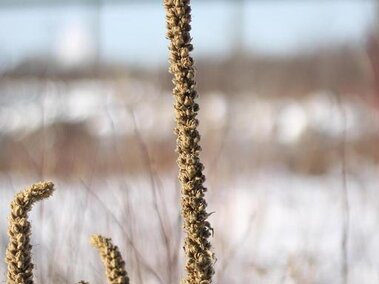
After flowering the entire plant dies – there is no vegetative reproduction. The dead flower stalks are rather persistent, so it easy to detect colonies of this weed at most times of year.
Leaves
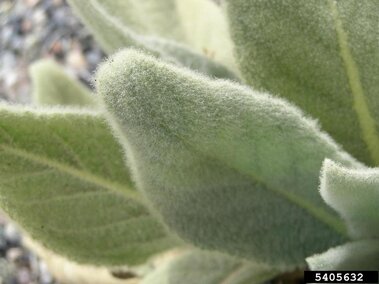
First-year plants appear as low-growing rosettes of felt-like leaves, with the whorl of leaves emerging from the root crown at the soil surface. Bluish gray-green, oblong to lanceolate leaves are 4-12″ long and 1-5″ wide, and are densely covered in hairs.
Stems
In spring of the second year, the plant bolts an erect stem that grows 2 to 6 feet tall. Occasionally, one or two side stems may develop in the upper half of the plant. These stems are covered with downy white hairs.
Seeds
Common mullein fruit is a rounded capsule that splits into two valves at maturity, each containing dozens of tiny brown seeds. The six-sided seeds are pitted and rough with wavy ridges and deep grooves. Individual plants produce 200-300 seed capsules, each containing 500-800 seeds, so a single plant can potentially produce 100,000‑240,000 seeds. Most seeds fall within a few feet of the parent plant, falling from the capsules when the flower stalk is moved by wind or a large animal. There are no adaptations for long distance dispersal.
The tiny seeds remain viable for decades in the soil. Seeds do not germinate well without light, so only those seeds which lie at or near the soil surface germinate, thus populations can reappear quickly after many years when seeds are brought to the surface by soil disturbance. Seedlings emerge almost entirely on bare soil, such as openings created by animal digging or road construction machinery.
Photos

Where Does It Grow?
Common mullein is typically found in neglected meadows and pasture lands, along fence rows and roadsides, in vacant lots, wood edges, forest openings and industrial areas.
How Does It Spread?
Common mullein was probably introduced to North America several times as a medicinal herb, and in the mid‑1700’s was used in Virginia as a piscicide (fish poison). Common mullein spread rapidly and had become so well established by 1818 was described as native on the East coast, reached the Midwest by 1839, and became widely naturalized on the Pacific Coast by 1876. Today common mullein is distributed throughout the U.S. and Canada wherever the growing season is at least 140 days and annual rainfall is sufficient (20 to 59 inches, or 50-150 cm), especially on dry sandy soils.
How Do I Control It?
Mechanical
Common mullein is easily managed in smaller areas by manually removing the plants before flowering, preventing soil disturbance and establishing dense vegetative cover that will prevent seed germination. In larger areas, such as nature preserves, single plants and small groups on the edge of the infestation should be targeted first, then working deeper into the infestation. Pull, hoe or dig plants by hand (easiest when the soil is moist) as soon as they are big enough to hold onto, but before they go to seed.
Prescribed burning can also be used. Mowing is not effective, as the rosettes just increase in size and then bolt once mowing is stopped.
Contact your county weed control authority to determine appropriate removal methods.
Cultural
When buying hay or forage, check to make sure it is weed-free certified. Management should include proper grazing and rotational grazing techniques that would maintain rangelands and prevent invasion. Disturbed areas should be re-seeded with desirable species to prevent spread.
One way that invasive plant seeds and fragments can spread is in soil. Sometimes plants are planted purposefully. You can prevent the spread of invasive plants.
PlayCleanGo: Stop Invasive Species in Your Tracks
REMOVE plants, animals and mud from boots, gear, pets and vehicles.
CLEAN your gear before entering and leaving the recreation site.
STAY on designated roads and trails.
PLANT non-invasive species.
Chemical
Herbicides are generally only used when infestations are very dense but may not be effective because the hairy leaf surfaces reduces absorption of chemicals.
Please refer to the 2025 Guide for Weed, Disease and Insect Management in Nebraska or contact your county weed control authority.
What Should I Do If I See It in Nebraska?
If you see common mullein in Nebraska, you should report it to your county weed control authority. For guidance on what information to include in your report, check out our reporting tips.
References and More Information
California Invasive Plant Council
Center for Invasive Species and Ecosystem Health
Colorado Department of Agriculture
National Invasive Species Information Center
Nebraska County Designated Noxious Weeds
Nebraska Department of Agriculture
Nebraska Weed Control Association
Nebraska Weed Free Forage Program
North Carolina Extension Gardener Plant Toolbox
Stubbendieck, J., Coffin, M., & Dunn, C. (2019). Weeds of the Great Plains. Nebraska Department of Agriculture.