
General Information
Species Name: Bothriochloa bladhii
Also Known As: Australian bluestem, Australian beardgrass, Caucasian beardgrass
Family: Poaceae (Grass)
Growth Form: Grass
Life Span: Perennial
Flowering Dates: July-October
Origin: Australia, Africa, Asia
Toxic: No
Noxious: No
Why Is It Invasive?
One of the Old World Bluestems, which includes yellow bluestem (Bothriochloa ischaemum), Caucasian bluestem is an aggressive, warm-season (C4) bunchgrass that quickly dominates pastures and rangelands. They outcompete native grasses, reducing biodiversity and forage quality. They are not as palatable or nutritious compared to native bluestems; often, cattle will not eat them at all. They are also allelopathic, meaning they release chemicals into the soil that inhibits the growth and reproduction of neighboring plants, putting native plants at a disadvantage.
What Does It Look Like?
General Characteristics
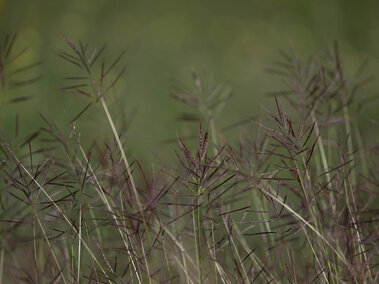
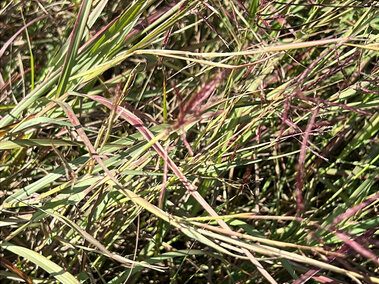
Caucasian bluestem grows 1-4 ft tall and produces short rhizhomes.
Flowers
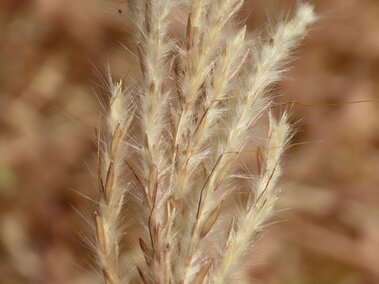
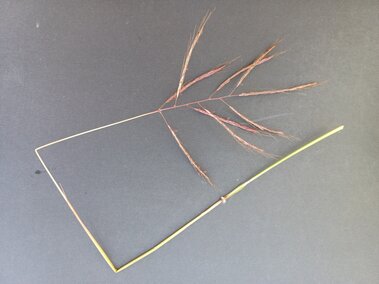
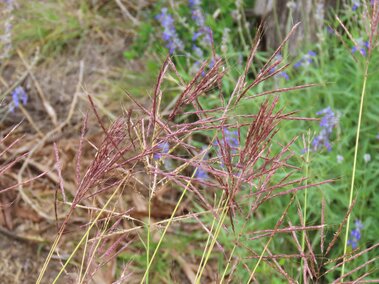
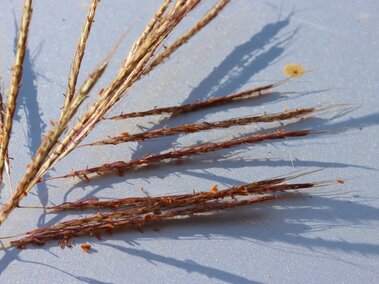
Has very small, silky flower heads on the end of its spikelets that start metallic red and fade to tawny buff. The seedheads at the end of the plant resemble a Christmas tree when flowering.
Leaves
Leaves grow directly from the main stem with smooth leaf blades from 8-14 in. (20-35 cm) long and 0.04-0.2 in. (1-4.5 mm) wide. There is a thin and translucent joint where the leaf blade and stem stem join that is from 0.02-0.06 in. (0.5-1.5 mm) long with sparse white hairs. Leaves have a strong turpentine smell when crushed. They start as a blue-gray color and become more silvery once they flower.
Stems
Hollow stems are erect and grow 40-90 cm.
Seeds
Fruits are lance-shaped or oblong-shaped and somewhat flattened.
Photos


Where Does It Grow?
Pastures, prairies, roadsides, disturbed sites, and waste areas. It is adapted to dry and relatively sterile soils but prefers heavy clay loam soils to clay soils and heavier alluvial soils. Caucasian bluestem seems to be more common in southeast Nebraska with one county in the northeast.
How Does It Spread?
Caucasian bluestem was introduced as a pasture grass and for erosion control. It quickly escaped and is nearly impossible to control in pastures and prairies. The first indication of a problem is a grass your cattle will not touch. Also, invasion usually begins around stock tanks.
How Do I Control It?
Mechanical
Please contact your county weed control authority to determine appropriate removal methods.
Cultural
When buying hay or forage, check to make sure it is weed-free certified. Management should include proper grazing and rotational grazing techniques that would maintain rangelands and prevent invasion. Disturbed areas should be re-seeded with desirable species to prevent spread.
One way that invasive plant seeds and fragments can spread is in soil. Sometimes plants are planted purposefully. You can prevent the spread of invasive plants.
PlayCleanGo: Stop Invasive Species in Your Tracks
REMOVE plants, animals and mud from boots, gear, pets and vehicles.
CLEAN your gear before entering and leaving the recreation site.
STAY on designated roads and trails.
PLANT non-invasive species.
Herbicide
Please refer to the 2025 Guide for Weed, Disease and Insect Management in Nebraska and/or contact your county weed control authority.
References and More Information
Center for Invasive Species and Ecosystem Health
Consortium of Great Plains Herbaria
National Invasive Species Information Center
Nebraska County Designated Noxious Weeds
Nebraska Department of Agriculture
Nebraska Weed Control Association
Nebraska Weed Free Forage Program
Stubbendieck, J., Coffin, M., & Dunn, C. (2019). Weeds of the Great Plains. Nebraska Department of Agriculture.