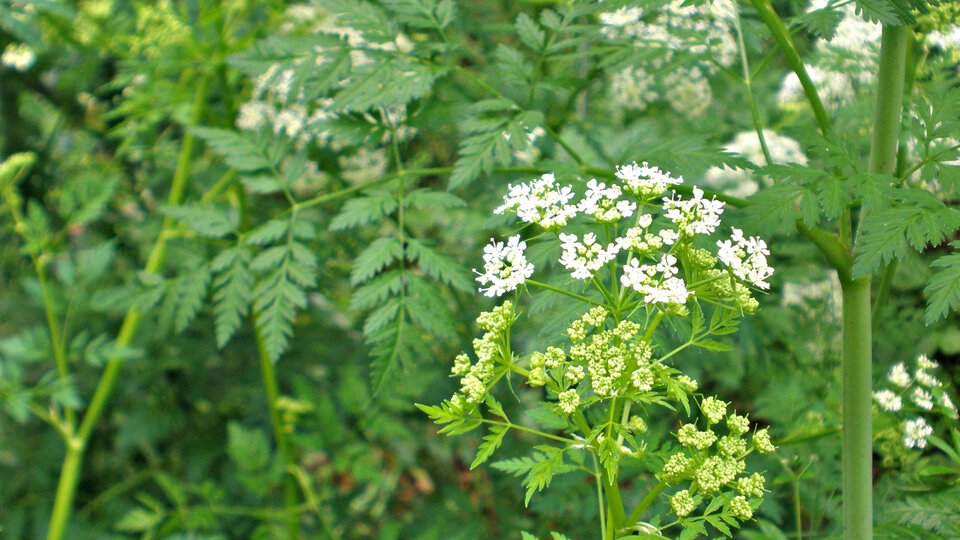
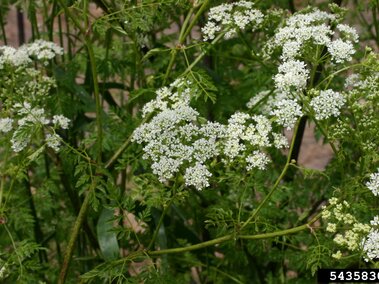
Credit: Ansel Oommen, Bugwood.org
General Information
Species Name: Conium maculatum
Also Known As: poison parsley
Family: Apiaceae (Carrot)
Growth Form: Forb
Life Span: Biennial
Flowering Dates: May-July
Origin: Europe
Toxic: Yes; ingestion by livestock or humans can result in death
Noxious: No
Why Is It Invasive?
Poison hemlock grows in dense patches, displacing and outcompeting native vegetation in pastures, rangelands, meadows, and disturbed sites. Poison hemlock is highly toxic to people and livestock. Ingestion of small amounts can result in death.
What Does It Look Like?
General Description
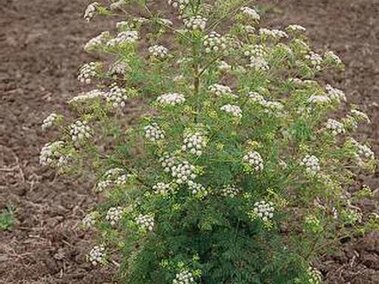
Poison hemlock is a herbaceous plant that appears as a low-growing rosette in its first year and develops into a tall flowering stalk in its second year that can grow up to 8 feet tall.
Flowers
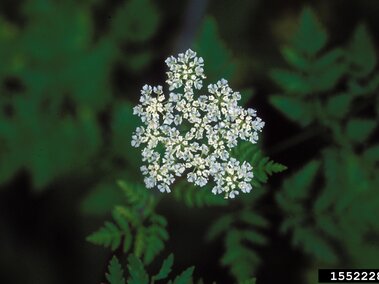
Flowers are white and have 5 notched petals. They grow in bunches at the end of stems.
Leaves
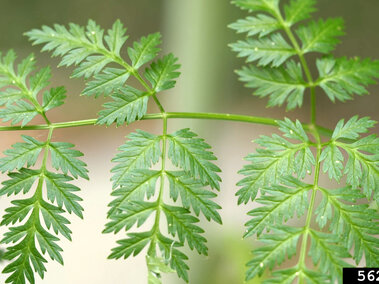
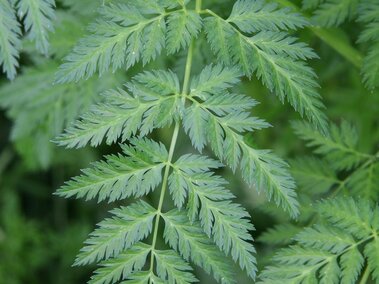
Leaves are alternately arranged on the stem and may be oppositely arranged at the top of the stem. Leaves appear fern-like and are separated into smaller leaflets. Leaflets have toothed margins and are smooth without hairs.
Stems
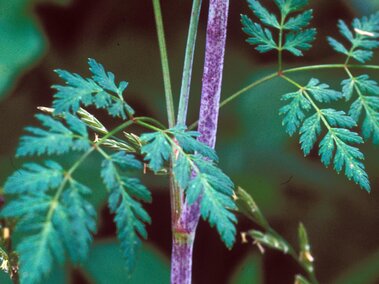
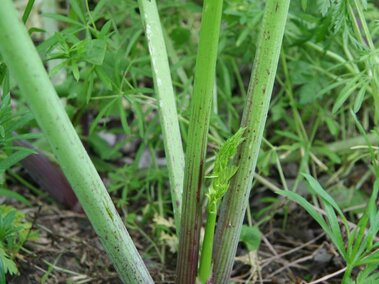
Stems are upright and highly branching. They are ridged and have purple blotches. Stems are smooth without hairs.
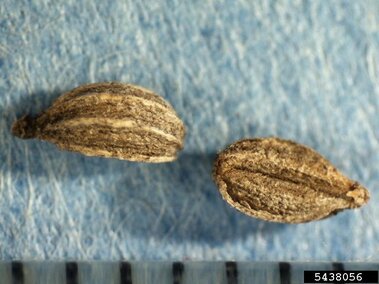
Seeds
Seeds are smooth and flattened or concave.
Photos
Where Does It Grow?
Poison hemlock can be found throughout North America. It commonly grows along roadsides, in pastures, rangelands, and meadows. It is most competitive in moisture-rich soils, but can also survive in dry sites.
How Does It Spread?
Poison hemlock was originally brought to the United States as an ornamental plant in the 1800s. It reproduces by seed which can be dispersed by natural vectors or by people. Each plant can produce nearly 50,000 seeds, which fall near the parent plant.
What are Symptoms of Toxicosis?
Individuals experiencing poison hemlock toxicosis may experience the following symptoms:
Trembling
Poor muscle coordination, especially in lower and hind limbs
Stimulation followed by depression
Dilation of pupils
Rapid, weak pulse
Respiratory paralysis
Coma
Convulsions
Death
Skeletal birth defects in cattle
How Do I Control It?
Mechanical
Small infestations can be hand removed. Ensure that the entire taproot has been removed and try to minimize soil disturbance to prevent seed germination. Bag plants and dispose in a garbage receptable. Mow before seeding to help reduce seed spread.
Please contact your county weed control authority to determine appropriate removal methods.
Cultural
Do not permit livestock to graze in areas infested with poison hemlock due to its high toxicity. When buying hay or forage, check to make sure it is weed-free certified.
One way that invasive plant seeds and fragments can spread is in soil. Sometimes plants are planted purposefully. You can prevent the spread of invasive plants.
PlayCleanGo: Stop Invasive Species in Your Tracks
REMOVE plants, animals and mud from boots, gear, pets and vehicles.
CLEAN your gear before entering and leaving the recreation site.
STAY on designated roads and trails.
PLANT non-invasive species.
Herbicide
Please refer to the 2026 Guide for Weed, Disease and Insect Management in Nebraska and/or contact your county weed control authority.
References and More Information
Michigan State University Extension Service
Minnesota Department of Agriculture
Nebraska Weed Control Association
Nebraska Weed Free Forage Program
North American Invasive Species Management Association Fact Sheet
Stubbendieck, J., Coffin, M., & Dunn, C. (2019). Weeds of the Great Plains. Nebraska Department of Agriculture.
USDA Agricultural Research Service
University of California Statewide Integrated Pest Management Program
University of Maryland Extension
Washington State Noxious Weed Control Board