General Information
Species Name: Lepidium latifolium
Also Known As: broadleaf pepperweed, tall whitetop, giant whitetop
Family: Brassicaceae (Mustard)
Growth Form: Forb
Life Span: Perennial
Flowering Dates: June-September
Origin: Eurasia
Toxic: No
Noxious: No
Why Is It Invasive?
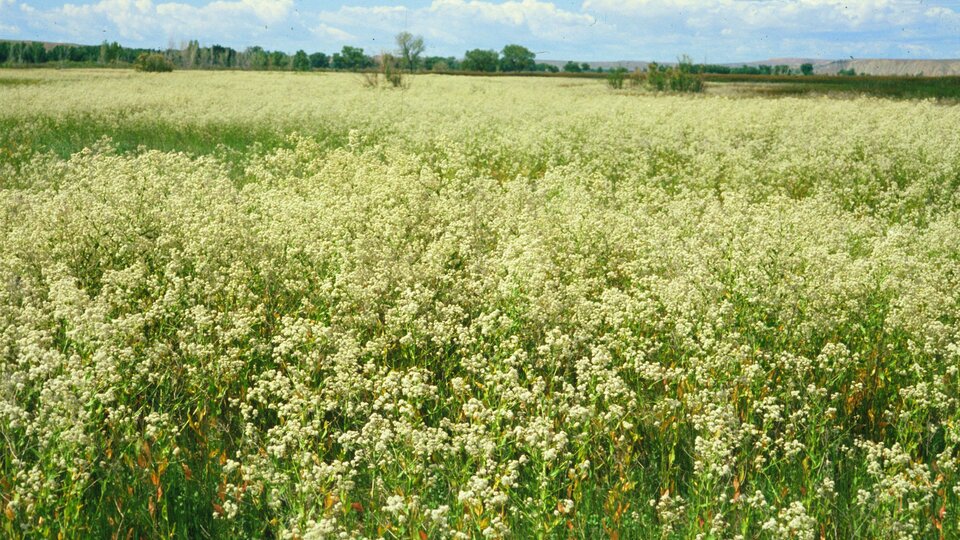
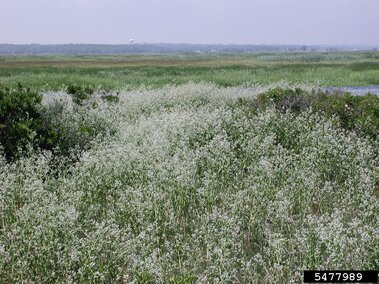
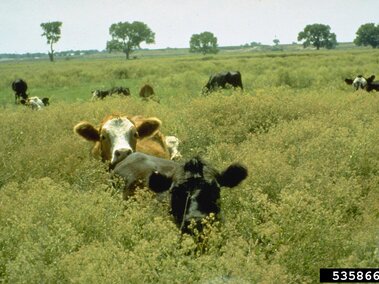
Perennial pepperweed is an invasive plant that can form dense monocultures and displace native plants and desirable forage. Woody stems also degrade nesting habitat for wildlife.
What Does It Look Like?
Flowers
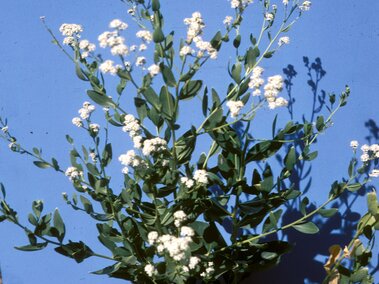
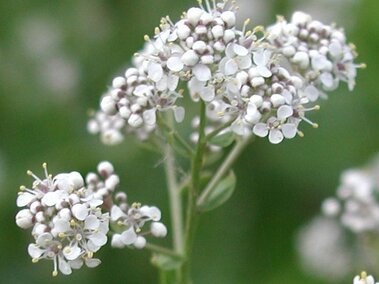
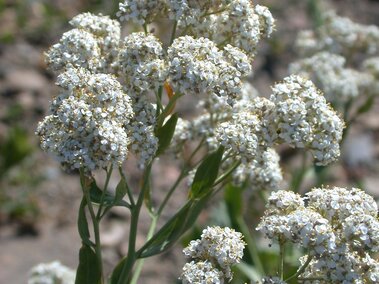
Flowers are white and have 4 spatula-shaped petals. They grow in clusters at the tips of stems.
Leaves
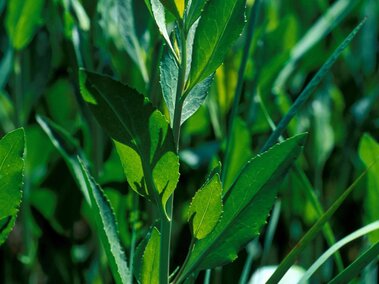
Leaves are alternately arranged about the stem. They are waxy and may have smooth or toothed margins. They range in color from green to grayish green.
Stems
Stems are upright and semi-woody. Stems emerge from a woody base.
Seeds
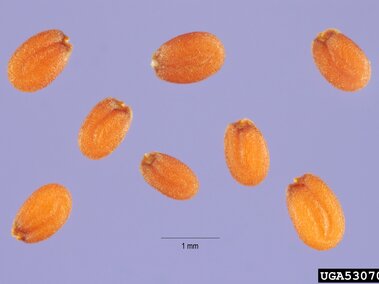
Round, flattened, and somewhat hairy. Reddish-brown in color.
Photos
Where Does It Grow?
Perennial pepperweed prefers wet conditions and can be found in ditches, salt marshes, irrigation channels, rangeland habitats, wetlands, and disturbed sites. It is widespread throughout the United States.
How Does It Spread?
Perennial pepperweed reproduces through seed, rhizomes, and root fragments. Creeping rhizomes may extend up to 6 feet away from the parent plant. Seeds can spread through natural causes or human vectors, including contaminated agricultural shipments and by attaching to clothing, shoes, pets, and equipment. Perennial pepperweed first arrived to North America in the early 1900s as a contaminant in sugar beet seed.
How Do I Control It?
Mechanical
Due to perennial pepperweed's brittle roots and ability to reproduce through root fragments, manual removal is not recommended and can actually help spread the plant. Spring mowing, in combination with other control methods, can be effective.
Please contact your county weed control authority to determine appropriate removal methods.
Cultural
Plant competitive and desirable vegetation to help prevent against perennial pepperweed establishment. Most livestock will not graze on perennial pepperweed and there have been cases of toxicosis linked to grazing in equines. Permitting goats to graze on perennial pepperweed infested fields may aid in control. When buying hay or forage, check to make sure it is weed-free certified.
One way that invasive plant seeds and fragments can spread is in soil. Sometimes plants are planted purposefully. You can prevent the spread of invasive plants.
PlayCleanGo: Stop Invasive Species in Your Tracks
REMOVE plants, animals and mud from boots, gear, pets and vehicles.
CLEAN your gear before entering and leaving the recreation site.
STAY on designated roads and trails.
PLANT non-invasive species.
Herbicide
Please refer to the 2026 Guide for Weed, Disease and Insect Management in Nebraska and/or contact your county weed control authority.
References and More Information
Colorado Department of Agriculture
Montana State University Extension
Nebraska Weed Control Association
Nebraska Weed Free Forage Program
New Hampshire Department of Natural Resources
Stubbendieck, J., Coffin, M., & Dunn, C. (2019). Weeds of the Great Plains. Nebraska Department of Agriculture.
U.S. Forest Service Southwest Region
University of California Statewide Integrated Pest Management Program
University of New Hampshire Extension
Washington State Noxious Weed Control Board
Wisconsin Department of Natural Resources