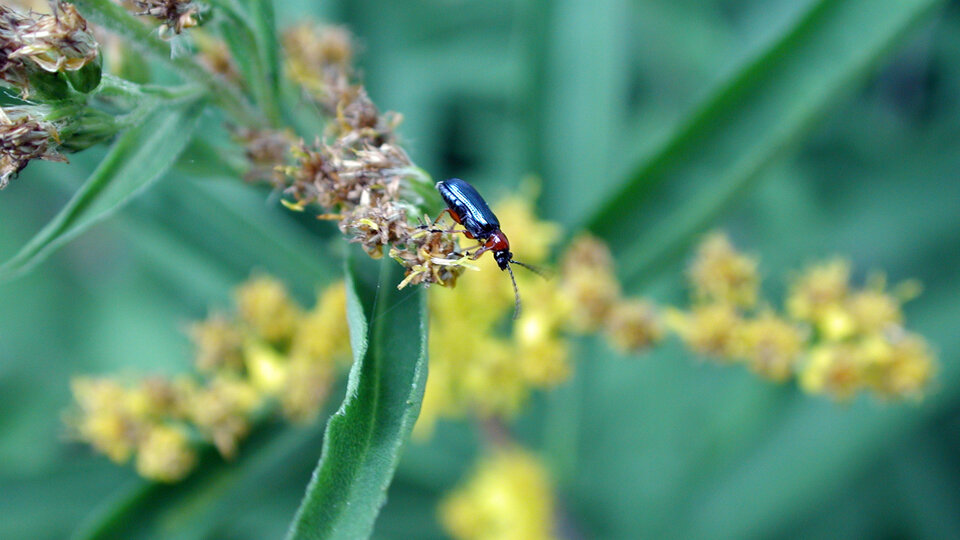
Credit: Hania Berdys, Bugwood.org
General Information
Species Name: Oulema melanopus
Also Known As: CLB
Family: Chrysomelidae (Leaf Beetles)
Life Cycle: Complete (egg > larvae > pupae > adult)
Activity: Larvae emerge in late spring and consume/damage crops
Origin: Europe and Asia
Why Is It Invasive?
CLB larvae and adults feed on small grains including barley, wheat, and oat plants, stripping green tissue from leaf veins. This severely damages crops before they can be harvested, harming agricultural communities and economies. If left untreated, some crop yields can decrease by 30-50% when infested. Most of the damage done by CLB occurs during the larval stage.
What Does It Look Like?
Adult Beetle
Adult beetles are small, only about 1/4 inch long. They have a brightly colored orange-red thorax and metallic blue heads and wing covers.
Larval Stage
CLB larvae reach about 1/4 inch long and are plump. They have pale yellow bodies and dark brown heads. They may appear somewhat dark and shiny as they cover themselves in an excrement coating for protective purposes.
Pupae
Pupae are typically not seen, as they are underneath the soil surface. They are yellow and look similar to adults but with poorly developed wings.
Eggs
Newly laid eggs are bright yellow or orange and fade into an orange-brown, eventually turning black prior to hatching. They are football shaped with rounded edges and very small, less 1/16 inch long, and deposited in groups of 2-3.
Photos
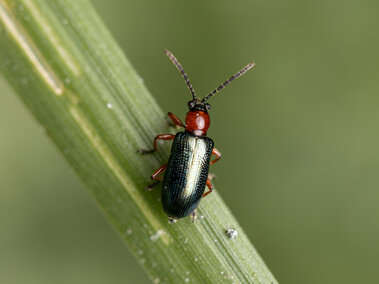
Credit: © Adrienne van den Beemt, some rights reserved (CC-BY)
CLB Adult
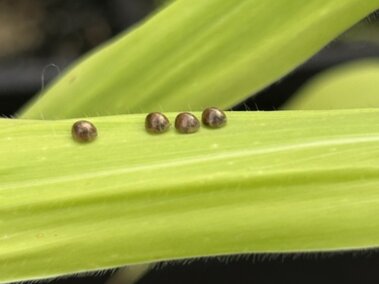
Credit: © Hannah Veee, some rights reserved (CC-BY-NC)
CLB Eggs
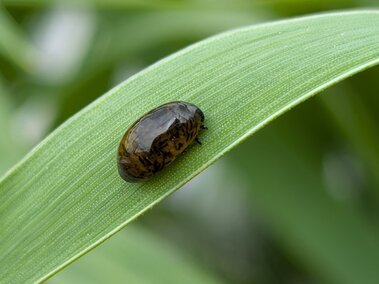
Credit: © Rain, some rights reserved (CC-BY-NC)
CLB Larva
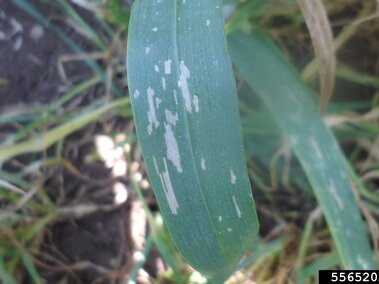
Signs of Infestation
Because larvae strip the leaf tissue from the upper surface, they may leave the leaf looking white or translucent. Heavily infested fields may have a "frosted" appearance.
Where Do They Live?
CLB are established intermittently throughout North America. They are most commonly found in rural areas with where their hosts species are present. They can be found in plant stems, under bark or plant debris, and in manmade structures. Host species include small grains, with preference for barley, wheat, and oats, canary grasses, ryegrasses, and foxtail.
How Do They Spread?
CLB was initially introduced to North America in the mid 1900s in contaminated agriculture shipments. It has since spread through natural expansion.
What Do I Do if I Find Them?
If you see a cereal leaf beetle or symptoms of cereal leaf beetle in Nebraska, report it to the Nebraska Invasive Species Council. For guidance on what information to include in your report, check out our reporting tips.
How Do I Control Them?
Cultural
Cereal leaf beetles prefer to colonize weakened plants, so promote high quality small grain to prevent infestation by emerging adults. Avoid planting small grains in the spring since adults prefer younger growth. Early-planted fields are less susceptible to infestation. Heavy irrigation may kill larvae.
Chemical
Please refer to the 2026 Guide for Weed, Disease and Insect Management in Nebraska, contact your county weed control authority, or find a certified Nebraska arborist.
References and More Information
Cornell Integrated Pest Management
Government of Ontario Crop Integrated Pest Management
Michigan State University Extension
Montana State University Extension
North Carolina State University Extension
North Dakota State University Extension Service
Oregon State University Pacific Northwest Nursery Integrated Pest Management
Pennsylvania State University Extension
Utah State University Plant Health Extension
Washington State University Dryland Cropping Systems Team