General Information
Species Name: Lymantria dispar
Family: Erebidae (moths)
Life Cycle: Complete (egg > caterpillar > pupae > adult)
Activity: Large outbreaks within an area every 10-12 years; adults appear mid to late summer; caterpillars result in the most damage to trees
Origin: Europe
Why Is It Invasive?
Spongy moth caterpillars heavily feed on deciduous trees and shrubs. While most trees can withstand some defoliation, spongy moths cause extreme defoliation resulting in tree stress, increasing tree susceptibility to pest and disease infestation. Tree loss can result in drastic ecosystem changes, impacting wildlife and other plant species and decreasing an area's biodiversity. Spongy moth caterpillars can consume 1 square foot of foliage every 24 hours and defoliate more than one million acres annually in the United States. Additionally, spongy moth caterpillars can cause some people to contract a rash upon contact with skin.
What Does It Look Like?
Adult Moth
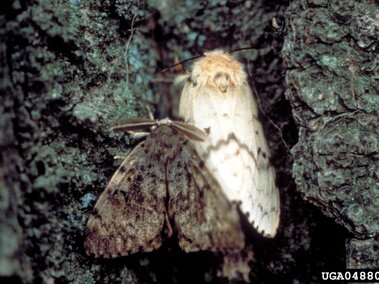
Female - Females have wings but do not fly and have heavy bodies. They will crawl on trees and wait for a mate to approach them. Female wings are mostly white and have a slightly larger wingspan than males.
Male - Males can fly and have light tan to dark brown colored wings. Their wingspan reaches about 1.5 inches. They can be found flying together in large numbers.
Caterpillar Stage
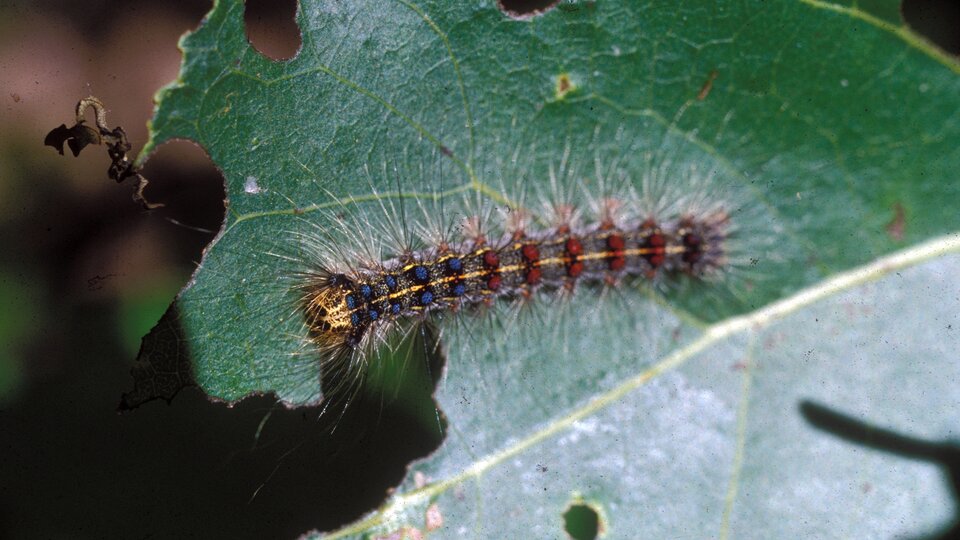
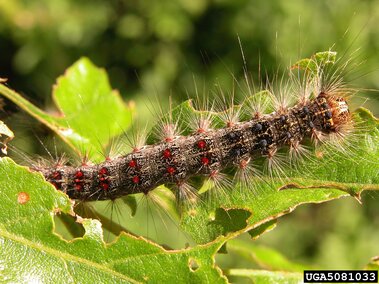
Spongy moth caterpillars are dark brown or nearly black and very fuzzy. They have six pairs of red dots and five pairs of blue dots on their back when mature and reach about 2 inches long.
Pupae
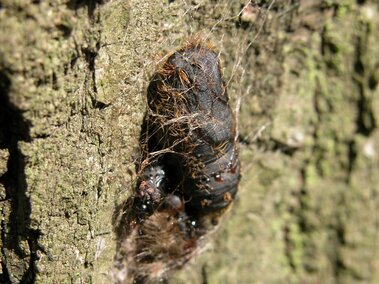
Pupae are dark brown and shaped like conical cylinders. They reach 3/4-1.5 inches long and will attach to many surfaces, including trees, buildings, and rocks.
Eggs
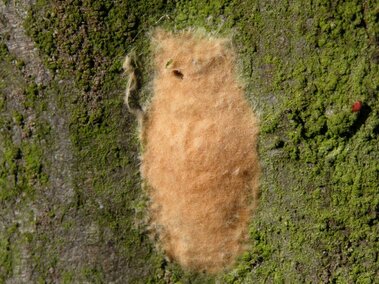
Egg masses consist of 100-600 eggs and are yellowish brown colored and somewhat hairy. They can be found on various surfaces including trees, buildings, and rocks.
Life Cycle and Behavior
In mid-to-late summer, adult spongy moths will lay egg masses on trees, rocks, buildings, or another solid surface. The following spring, caterpillars will hatch and move away from the egg mass to feed on leaves. Spongy moth caterpillars can feed on more than 300 species of deciduous and evergreen trees. Caterpillars consume foliage at a rapid rate, with one individual capable of consuming 1 square meter of foliage every 24 hours. Spongy moths remains in the caterpillar stage for about 7 weeks and then pupate in well-protected locations. An adult moth emerges from the pupa after 10-14 days. Female moths cannot fly and will rest on trees, emitting pheromones so that males can find them. Males fly erratically during the daytime trying to find a mate and may move together in large quantities.
Once established, spongy moth outbreaks may occur every 10-12 years, during which spongy moth numbers temporarily substantially increase for 2-3 years.
Photos
Credit: John Ghent, John Ghent, Bugwood.org
Female (white) and male (brown) adult spongy moth
Credit: Ferenc Lakatos, University of Sopron, Bugwood.org
Spongy moth pupa
Credit: Ferenc Lakatos, University of Sopron, Bugwood.org
Spongy moth caterpillar
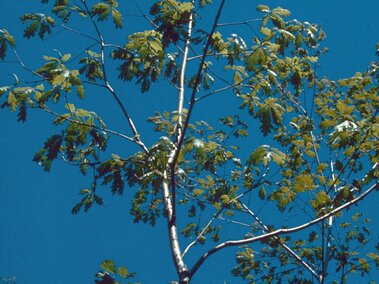
Credit: USDA Forest Service , USDA Forest Service, Bugwood.org
Spongy moth defoliation/damage
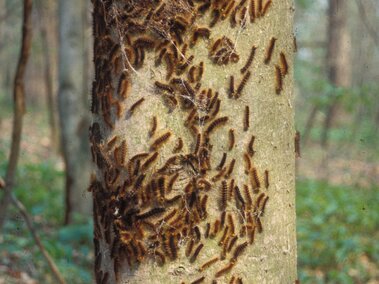
Credit: Daniel Herms, The Ohio State University, Bugwood.org
Spongy moth caterpillar infestation
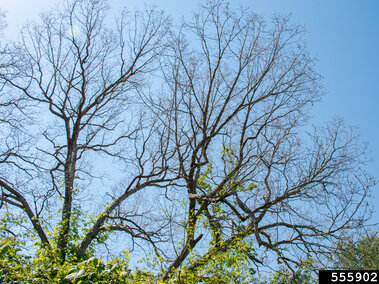
Credit: Karla Salp, Washington State Department of Agriculture, Bugwood.org
Spongy moth defoliation/damage
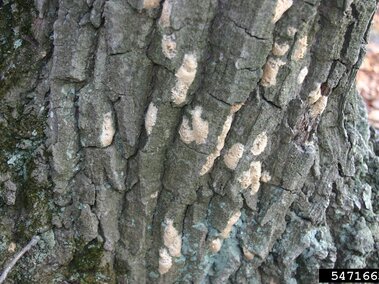
Credit: Leslie J. Mehrhoff, University of Connecticut, Bugwood.org
Spongy moth egg mass infestation
Where Do They Live?
Spongy moth is currently present in the Northeastern United States and have been found as far west as Kansas. Male spongy moths have been documented in Nebraska, but no females have ever been confirmed. Spongy moths can be found in forests and heavily treed areas that contain tree species within their diet. They prefer oaks, willows, crabapple, basswoods, lindens, and pines and will avoid ash, balsam, fir, dogwood, sycamore and catalpa trees.
How Do They Spread?
Spongy moth is spread by people. People may unknowingly move spongy moth, in all life stages, on firewood, lawn and outdoor equipment, lumber, and other items left outside.
What Do I Do if I Find Them?
If you see a spongy moth or signs of spongy moth infestation, report it to the Nebraska Plant Pest Program.
How Do I Control Them?
Cultural
Don't move or transport firewood and burn firewood in the area where you buy it. Check all vehicles and outdoor and lawn equipment for spongy moths, in all life cycles, before moving it from one location to another. Be especially vigilant in areas with known spongy moth infestations.
Avoid planting preferred hosts (oak, willow, apple, crabapple, white birch, witch hazel, mountain ash, basswood, linden, pine, Douglas-fir, spruce) of spongy moth and consider planting a spongy moth resistant tree community with trees that spongy moths avoid (ash, balsam, fir, locust, Scotch pine, red cedar, tulip poplar, catalpa, sycamore, dogwood).
Mechanical
Scrape caterpillars, egg masses, and adult moths into soapy water. Be sure to wear gloves when handling spongy moth caterpillars to avoid allergic reaction. Consider leaving diseased caterpillars, which are shaped like a capital V or are hanging head down upon death, to infect other caterpillars.
Consult an arborist on how to manage infested trees and how to develop healthy stands to prevent infestation.
Chemical
Please refer to the 2026 Guide for Weed, Disease and Insect Management in Nebraska, contact your county weed control authority, or find a certified Nebraska arborist.
References and More Information
Cornell Integrated Pest Management
Minnesota Department of Natural Resources
Missouri Department of Conservation
National Invasive Species Information Center
Nebraska Department of Agriculture Entomology Program
Ohio Department of Agriculture
USDA Animal and Plant Health Inspection Service
Wisconsin Department of Natural Resources