General Information
Species Name: Lonicera morrowii
Also Known As: Asian fly honeysuckle, bush honeysuckle, Morrow's bush honeysuckle
Family: Caprifoliaceae (Honeysuckles)
Growth Form: Shrub
Life Span: Perennial
Flowering Date: Mid to late spring
Origin: Eastern Asia
Noxious: No
Why Is It Invasive?
Morrow's honeysuckle forms dense monocultures, restricting sunlight and space for native species. It releases chemicals into the soil that restrict the growth of native plants. Morrow's honeysuckle reduces biodiversity, restricting plant and tree sapling growth in areas it has invaded including woodlands, fields, and disturbed sites.
What Does It Look Like?
General Characteristics
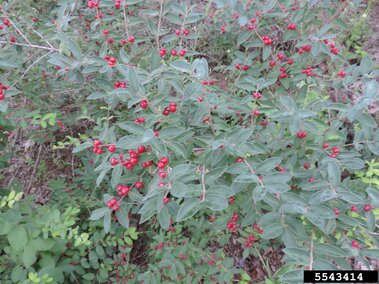
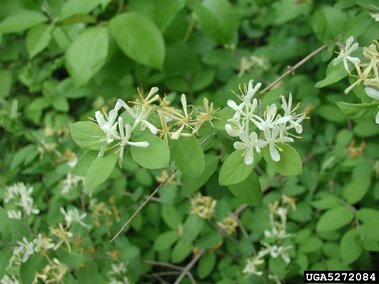
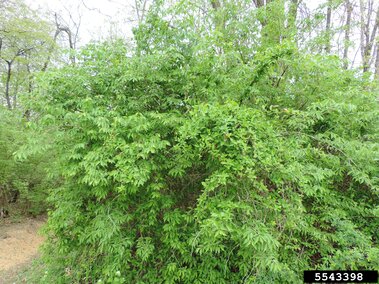
Deciduous shrub that can grow up to 8 feet tall.
Leaves
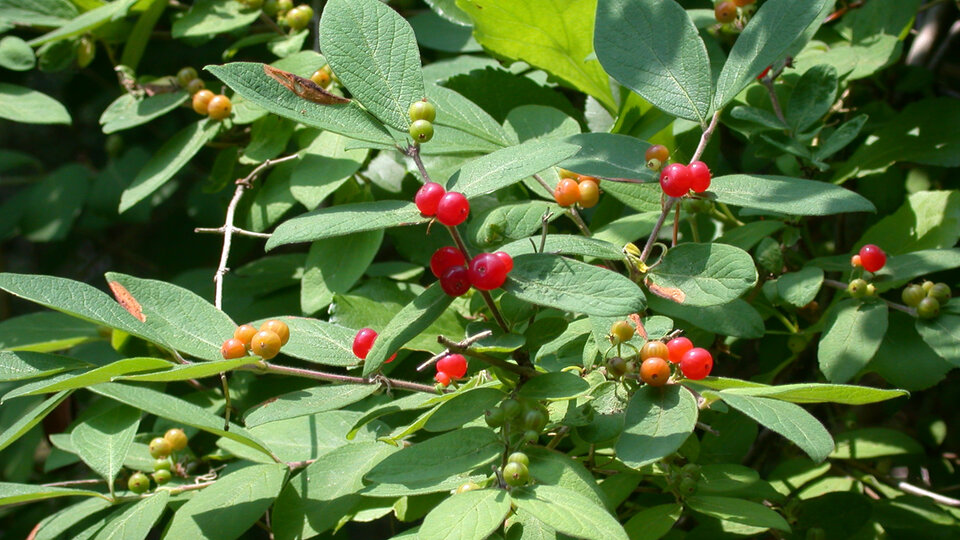
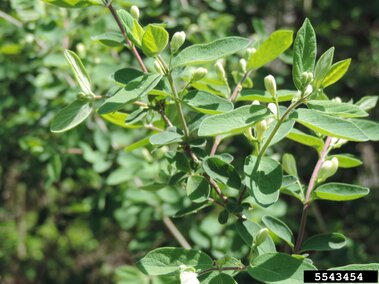
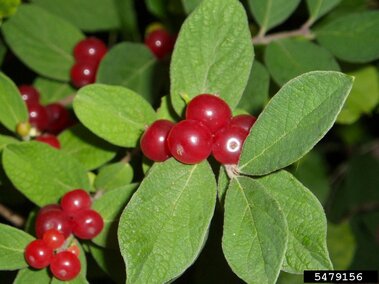
Leaves are oppositely arranged and oval to oblong with short, pointed tips. Leaves are gray-green in color and have small hairs on the underside.
Bark
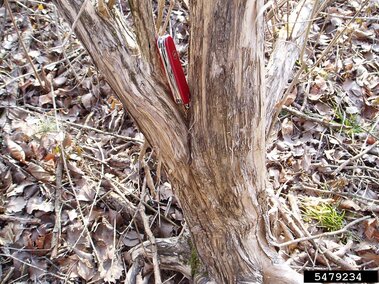
Bark is grayish brown and appears somewhat scaly.
Flower
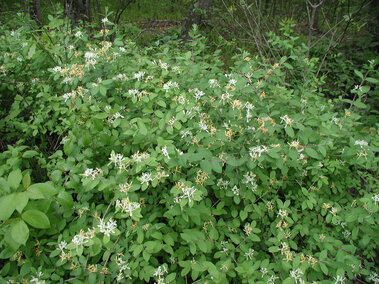
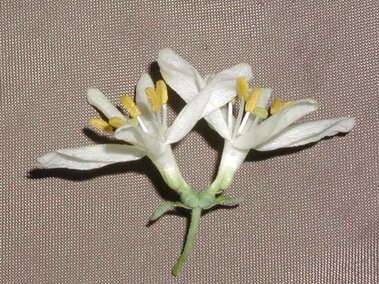
White or cream colored and yellow with age. Flowers are fragrant, tubular, and grow in pairs. Sepals are fuzzy.
Fruit
Red berries that grow in pairs and contain many seeds.
Photos
Where Does It Grow?
Morrow's honeysuckle invades woodlands, roadsides, fields, and disturbed areas. It can grow in full sun or shade and moist or dry soils. It is widespread throughout the Eastern and Midwest United States.
How Does It Spread?
Morrow's honeysuckle was initially introduced in the 1800s as an ornamental plant and for erosion control. It spreads primarily through seeds, which can be distributed great lengths by birds who eat the fruit of Morrow's honeysuckle.
How Do I Control It?
Once established, Morrow's honeysuckle is difficult to control. Repeated monitoring and control methods should occur for 3-5 years.
Mechanical
Seedlings and small to medium-sized plants can be dug or hand pulled.
Contact your county weed control authority to determine appropriate removal methods.
Cultural
Do not plant Morrow's honeysuckle as an ornamental plant. Consider planting a native alternative.
Herbicide
Please refer to the 2026 Guide for Weed, Disease and Insect Management in Nebraska and/or contact your county weed control authority.
References and More Information
Connecticut Invasive Plant Working Group
Invasive Plant Atlas of the United States
Maine Department of Agriculture, Conservation, and Forestry
Midwest Invasive Plant Network
Minnesota Department of Agriculture
Wisconsin Department of Natural Resources