Credit: Richard Gardner, Bugwood.org
General Information
Species Name: Lonicera japonica
Family: Caprifoliaceae (honeysuckles)
Growth Form: Vine
Life Span: Perennial
Flowering Dates: May-June
Origin: Eastern Asia
Noxious: No
Why Is It Invasive?
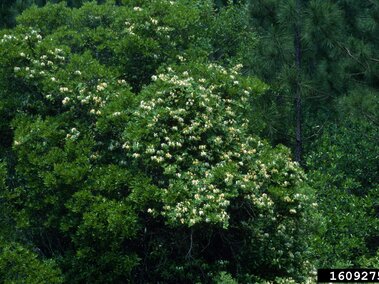
Japanese honeysuckle is a sprawling and climbing plant that easily outcompetes and smothers native plant species. It can grow up to 120 feet long and spreads both by seeds and rhizomes.
What Does It Look Like?
General Characteristics
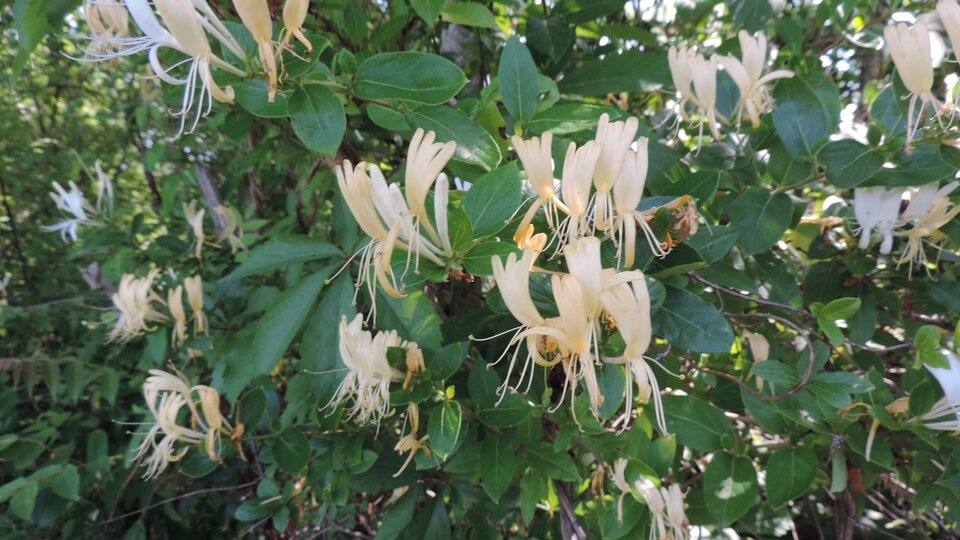
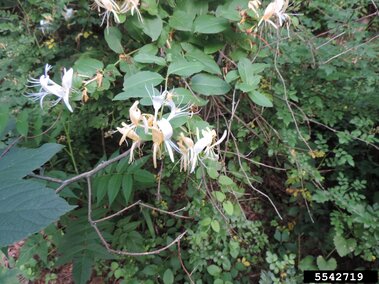
Japanese honeysuckle is a woody vine that has white and yellow fragrant flowers.
Flowers
Flowers are tubular and grow in pairs. They are white when they first bloom but fade to yellow and very fragrant.
Leaves
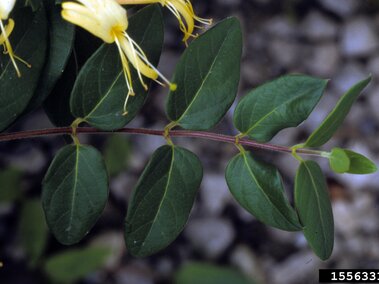
Leaves are oppositely arranged about the vine and ovate. They are deep green, glossy on the upper side, hairy on the underside, and have smooth margins.
Stems
Stems can grow up to 2 inches thick, are hollow and brown with bark that peels in strips. They are spreading and sometimes climbing. Stems may have small hairs. Young stems may be reddish.
Fruits
2-3 seeds are contained in small black or dark purple berries that appear in the fall.
Photos
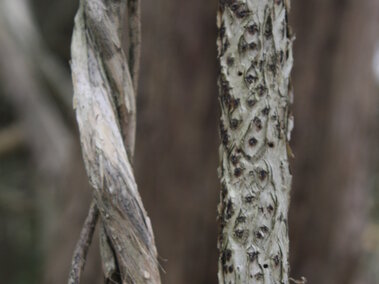
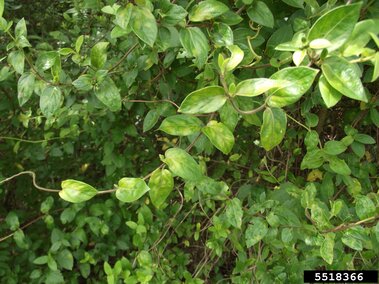
Credit: Richard Gardner, Bugwood.org
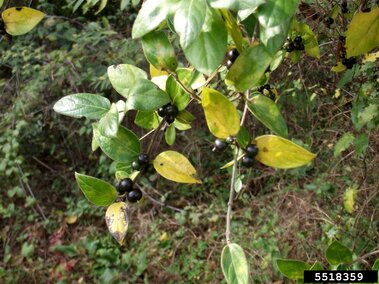
Credit: Richard Gardner, Bugwood.org
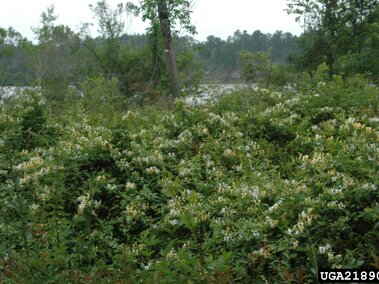
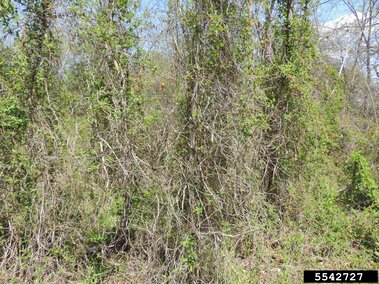
Credit: Richard Gardner, Bugwood.org
Where Does It Grow?
Japanese honeysuckle grows in disturbed sites, open areas like pastures and meadows, and in open woods. It prefers full sun but can successfully establish in shaded areas. It has been identified in most of the contiguous United States but has yet to be identified in the Northern Great Plains area.
How Does It Spread?
Japanese honeysuckle can spread through seed and vegetatively. Seeds can be transported by natural vectors like birds or through human vectors like accidental seed transport on clothing and equipment. Japanese honeysuckle also spreads through rhizomes, spreading underground and rooting where aboveground stems contact the ground.
How Do I Control It?
A combination of methods is needed to control or completely eradicate Japanese honeysuckle infestation.
Mechanical
Young plants and seedlings may be pulled by hand. Ensure you remove the entire underground root system when hand pulling.
Consistent cutting and mowing can help control established Japanese honeysuckle populations.
Contact your county weed control authority to determine appropriate removal methods.
Cultural
Do not plant Japanese honeysuckle as an ornamental plant. Plant a native alternative.
One way that invasive plant seeds and root fragments can spread is in soil. Sometimes plants are planted purposefully. You can prevent the spread of invasive plants.
REMOVE plants, animals and mud from boots, gear, pets and vehicles.
CLEAN your gear before entering and leaving the recreation site.
STAY on designated roads and trails.
PLANT non-invasive species.
PlayCleanGo: Stop Invasive Species in Your Tracks
Herbicide
Please refer to the 2026 Guide for Weed, Disease and Insect Management in Nebraska and/or contact your county weed control authority.
References and More Information
Minnesota Department of Agriculture
Missouri Department of Conservation
North Carolina State University Extension Gardener
State of Indiana Cooperative Invasive Species Management
Texas Invasive Species Institute
US Forest Service Native Plant Alternatives
University of Connecticut Integrated Pest Management