General Information
Species Name: Mus musculus
Family: Muridae (Old World Mice/Rats)
Origin: Central Asia
Why Is It Invasive?
House mice are a common pest to humans and have adapted well to living in close quarters with us. They eat and contaminate food supplies, transmit disease including salmonella, hantavirus and e-coli, and can damage structures and property.
Identification and Ecology
Physical Description
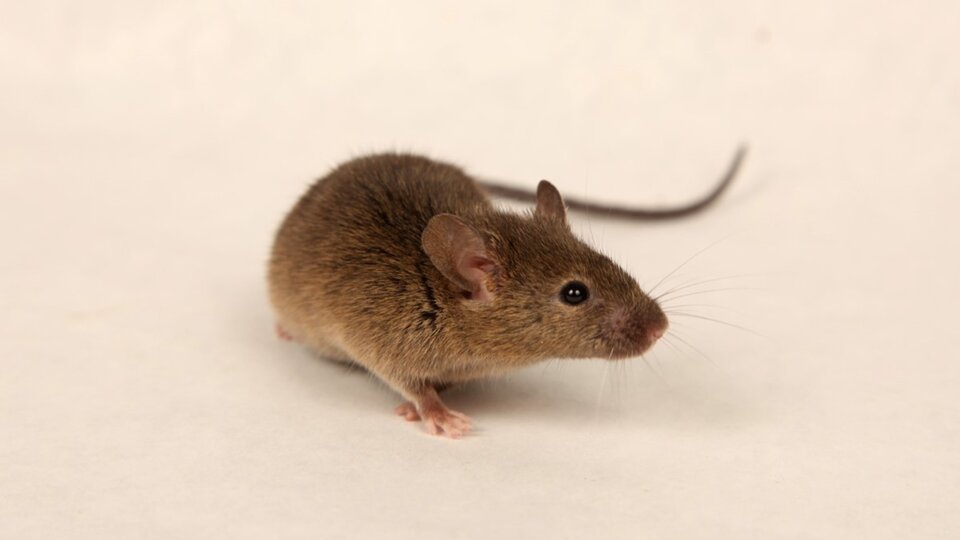
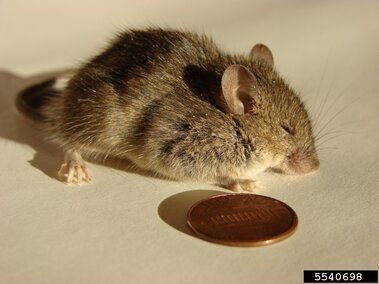
House mice are small rodents, averaging about half an ounce in weight and 5.5-7.5 inches in length. Their nearly naked tails are long, making up about half of their total length. They have light brownish to gray fur, somewhat large rounded ears, a pointed snout, and small, black eyes.
Life Cycle
House mice live about 1 year. They breed throughout the year with females reaching sexual maturity at about 45 days. The house mouse gestation period is about 45 days and litters consist of 2-10 pups. Although pups are helpless when born, they develop quickly and are weaned by 3 weeks old. One female may produce as many as 14 litters throughout her lifetime.
Behavior
The house mouse is a good climber and swimmer and is primarily nocturnal. They build nests in sheltered areas from shredded paper or other materials. They may eat about 200 small "meals" daily. They have keen senses and can detect movement up to 15 feet away.
Diet
House mice are omnivorous, preferring grains, stems, roots, insects, and human food.
Habitat
House mice can be successful in a variety of habitats, but are often found alongside humans.
Photos


Signs of Infestation
Gnawing
House mice gnaw on wood, chords and wires, and storage containers. You may notice small holes in food containers, or small, multitudinous teeth marks on harder surfaces.
Nesting
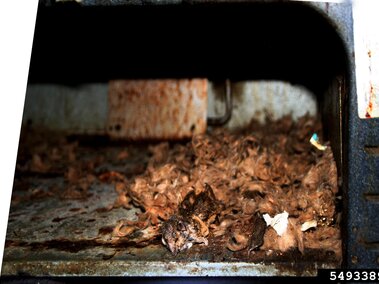
House mice create dens from finely shredded materials. Dens are often in sheltered locations and can be found in areas like cupboards and drawers.
Squeaking, Scratching, and Gnawing Sounds
House mice make somewhat quiet, high-pitched squeaking sounds that you may be able to hear. You may also hear the sounds of their claws scratching surfaces as they climb in walls and ceilings, or gnawing.
Droppings
House mice may leave small, dark, cylindrical droppings in areas they have inhabited.
Odor
A musky, ammonia-like odor may be indicative of a house mouse infestation.
Photos
Credit: Liz Kasameyer, Johns Hopkins School of Public Health, Bugwood.org
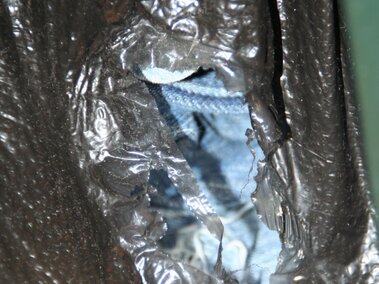
Mice will chew through plastics and other containers.
Credit: Liz Kasameyer, Johns Hopkins School of Public Health, Bugwood.org
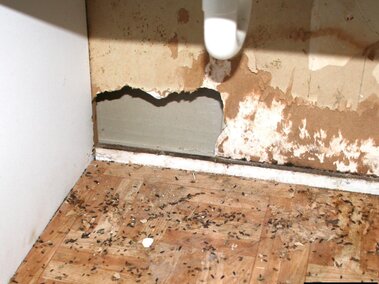
Mice will leave droppings, gnawing and scratch marks and chew through drywall.
Credit: Liz Kasameyer, Johns Hopkins School of Public Health, Bugwood.org
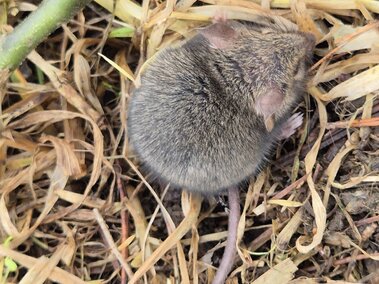
Mice create nests in small, sheltered areas with fibrous materials.
How Do They Spread?
House mice originally arrived to North America aboard settler ships. Since, they have been highly successful at establishing across the continent through human intervention and natural expansion.
Distribution
House mice are widespread across the United States and are now a common pest.
Control
While many control methods can be performed by individuals with no special training or credentials, consider calling a professional pest management company for large infestations or if you are not comfortable performing the control methods on your own.
Cultural
Cultural methods are primarily preventative and will need to be implemented in conjunction with mechanical methods during an active infestation.
Practice good sanitation to prevent attracting house mice into your home. Dispose of food waste in a tightly closed garbage or compost container and remove food waste from your home regularly. Clean up around pet food areas, remove old fruits and vegetables from your home, and properly store food in sealed containers.
Manage around your home that are well-suited for house mouse shelter by cutting lawns short, keeping gardens tidy, and sealing homes, sheds, and outbuildings. Keep equipment at least 18 inches off the ground if able. Consult a home construction company regarding rodent-proof construction.
Mechanical
Once an infestation has occurred, population reduction is almost always necessary. Utilize humane methods like wooden snap traps or rodenticide traps. Many traps and baits can purchased at hardware stores. Place baits in areas with evidence of mice activity. Be sure to place traps in areas away from children and pets and carefully select the method that is best-suited for your home's safety needs.
Electronic devices are typically ineffective, as mice quickly adapt to repeated sounds. Predators like cats and dogs are typically also no effective at population control.
What to Do if Sighted
If you see a house mouse of signs of a house mouse infestation in your home, refer to the above control methods and implement a control program promptly. Wear personal protective equipment like rubber gloves and a face mask when cleaning areas that have been inhabited by house mice. Wet droppings, urine, and nests thoroughly with a household disinfectant before cleaning. Remove and dispose of foods that have been contaminated by house mice and thoroughly clean areas that have been inhabited for using.
References and More Information
Illinois Department of Natural Resources
Illinois Department of Public Health
Kansas State University Extension Wildlife Management
Tennessee Wildlife Resources Agency
University of California Statewide Integrated Pest Management Program