
General Information
Species Name: Sturnus vulgaris
Family: Sturnidae (Starlings)
Origin: Eurasia and Northern Africa
Why Is It Invasive?
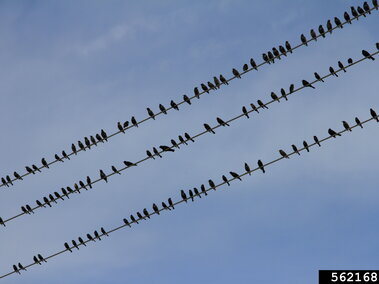
European starlings are often regarded as a pest due to their detrimental impact on agriculture and nuisance they can cause to people. Starlings will damage fruit, grain, and corn products by pecking at the crop or pulling sprouts of grains, destroying or significantly devaluing them. They travel in large flocks and may cover structures in feces, cause significant noise, clog vents and exhausts with nests, spread disease, and can pose significant hazard around airports if they fly into jet engines. They also compete with native birds for nesting sights and resources and hobbyist bird watchers may dismay at their aggressive behavior at bird feeders, chasing off native birds.
Identification and Ecology
Physical Description
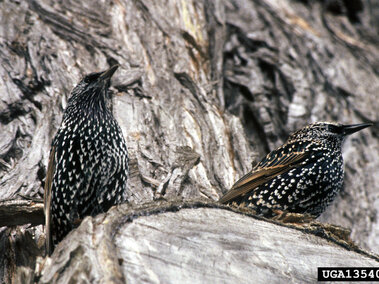
European starlings are about 8-9 inches in length, with a short tail and thin, straight bill. Throughout spring and summer, their feathers are iridescent black/purple/green with some white spots and yellow bills. In the fall and winter time they are black and brown with larger, more numerous white spots and black bills. Males are slightly larger than females.
The call of a European starling is squeaky and raspy without a consistent melody. They often imitate other birds.
Life Cycle
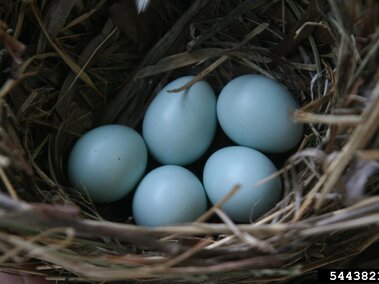
European starlings live for 2-3 years. They build nests in small, tight spaces and have 1-2 broods per year. Each brood contains 3-6 greenish or bluish white eggs. Incubation lasts about 12 days and fledglings leave the nest around 21-23 days of age.
Behavior
European starlings forage on the ground in open areas, on fruit trees, or catch insects in the air. They forage in large flocks. They build nests in small, tight spaces and males may have more than one mate. They can be very aggressive with other birds, chasing them away from food and nesting sites.
Diet
European starlings are omnivorous, consuming fruits, grains, and insects.
Habitat
Eurasian collared doves can be found in urban, suburban, and rural areas.
Photos





How Do They Spread?
European starlings were intentionally introduced to the United States, with the first recorded release in the 1890s in New York City. Since their introduction, they naturally expanded across the continent. There are an estimated 150 million starlings currently in North America.
Distribution
European starlings are widespread across the United States.
Control
Cultural
Perform habitat modification by removing potential nesting or perching sites for European starlings. These include tree stands, dense vegetation, and box piles, and other areas that may have small, tight spaces where a European starling may want to nest.
For areas with a high number of European starlings, exclusion may be preferable. Consider using netting for crops and buildings. Also consider using frightening devices to deter starlings from entering the area.
Mechanical
Shooting and trapping are often not viable or successful methods to reduce starling populations in an area.
References and More Information
All About Birds Cornell Lab of Ornithology
Missouri Department of Conservation
Minnesota Department of Natural Resources
National Invasive Species Information Center
USDA APHIS Wildlife Damage Management Technical Series
University of California Statewide Integrated Pest Management Program