General Information
Species Name: Aedes aegypti
Family: Culicidae (mosquitos)
Life Cycle: Complete (egg > larvae > pupae > adult).
Activity: Adults emerge in Nebraska mid-May through early August.
Origin: Asia
Why Is It Invasive?
Yellow fever mosquitos are not just pests, they are dangerous. They are known carriers of yellow fever, West Nile virus, Zika virus, and Dengue Fever. Asian tiger mosquitos are considered "container breeders" and lay eggs in small, contained water sources, natural or man-made. This can make them especially prominent in urban areas that may not normally have mosquitoes. They are persistent biters and bite both people and animals.
What Does It Look Like?
General Characteristics
Adult
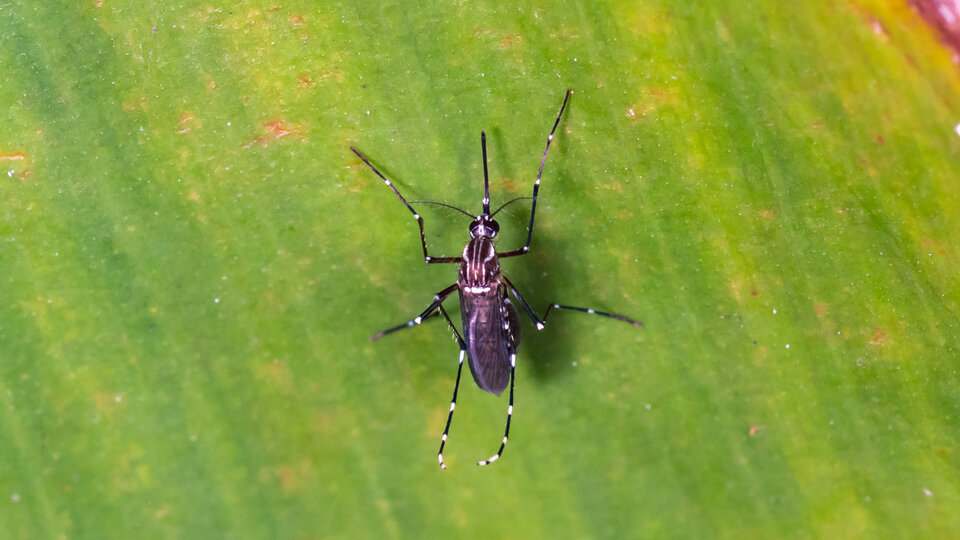
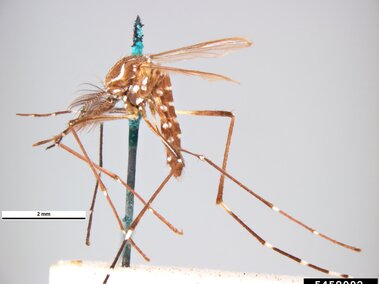
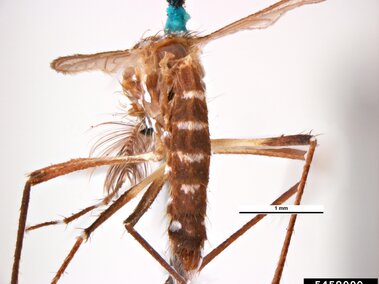
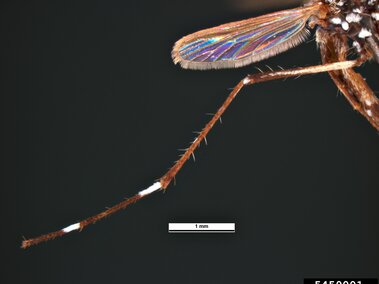
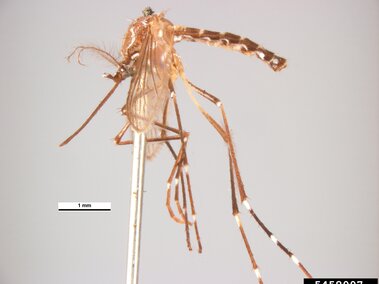
Adult yellow fever mosquitos are dark brown or black with white band on their legs and white spots on their body. Harp shaped stripes on their thorax distinguish this mosquito physically from lookalike Asian tiger mosquito, which has a single white stripe on the thorax.
Pupal Stage
The pupae are dark brown and comma-shaped. Pupae develop in the water and have a tumbling motion in water when disturbed.
Larvae
Larvae develop in the water, are worm-like, and have a wiggling motion when swimming.
Eggs
Eggs are small, dark brown, and cylindrical with a pointed tip. They can be found in containers with water above the waterline.
Photos
Where Do They Live?
Yellow fever mosquitoes can be found in urban environments, both indoors and outdoors. They are container breeders, laying eggs in anything that can collect and hold small amounts of water. While they do best in warm temperatures, eggs can survive winters and drying out for up to 8 months. Yellow fever mosquitos can be found worldwide and in the southern United States. There has been two documented cases of yellow fever mosquitoes in Nebraska.
How Do They Spread?
Yellow fever mosquitoes have been transported worldwide on ships. They spread further when breeding containers are transported by people. Most yellow fever mosquitoes do not fly more than 500 feet from their hatching site, making them slower expanders without human intervention.
What Do I Do If I Find Them?
You can report an Asian tiger mosquito sighting. Practice personal protection to avoid bites that could potentially result in disease transmission.
How Do I Control Them?
Mechanical
Reduce mosquito breeding habitats by turning over, covering, or throwing out items that can hold water including, but not limited to, tires, buckets, planters, toys, pools, or flowerpots. Be sure to remove small pools of standing water from your home and routinely clean and replace water in outdoor items intended to hold water such as bird baths, fountains, or pet bowls.
Cultural
Do not move open containers holding even small amounts of water. Drain and dry all objects of standing water before moving them from one location to another.
Pesticides
Larvacides for mosquito control can be purchased at local hardware or home improvement stores. Follow label instructions carefully and do not treat drinking water with pesticides. You can also contact a certified pesticide applicator.
Be Mosquito Safe
Practice personal protection by applying an EPA-registered repellant, wearing long sleeves and pants, and avoiding direct contact with mosquitoes.
References and More Information
Butte County Mosquito and Vector Control District
County of Santa Clara Mosquito and Vector Control District
California Department of Public Health
European Centre for Disease Prevention and Control
Jackson County Vector Control District
Mississippi State University Extension Series for Pest Management Professionals
Nebraska Department of Health and Human Services