General Information
Species Name: Convolvulus arvensis
Also Known As: smallflower bindweed, small bindweed, European bindweed, greenvine, creeping Jenny, bellbine, sheepbine, cornbind, perennial morningglory, devil's guts
Family: Convolvulaceae (Morningglory)
Growth Form: Forb
Life Span: Perennial
Flowering Dates: June-September
Origin: Eurasia
Toxic: No
Noxious: No
Why Is It Invasive?
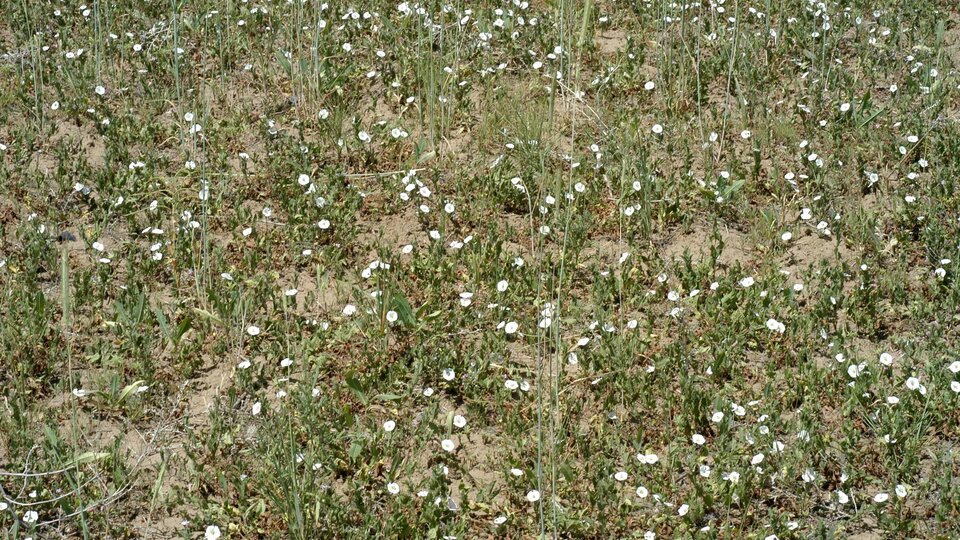
Field bindweed reduces crop yield in agricultural areas and can overtake lawns and gardens. It forms dense, tangled mats aboveground that crowd out desirable vegetation. It's extensive underground root system allows it to spread easily and it has the ability to climb upwards. Rhizomes are able to penetrate through plastic and fabric barriers, making it difficult to prevent or control.
What Does It Look Like?
General Characteristics
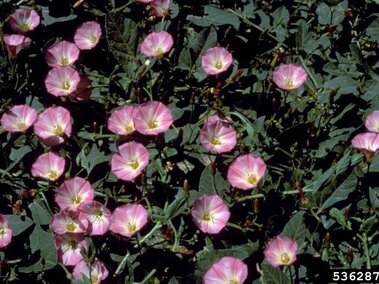
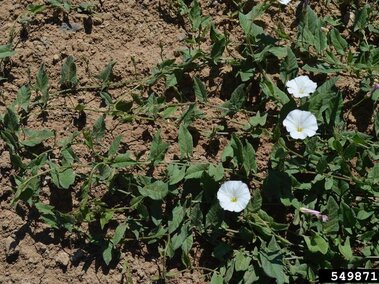
Field bindweed is an herbaceous plant with creeping, twining stems that grows along the ground or up structures and other plants. It has distinctive pink or white funnel-shaped flowers during flowering in the summer.
Flowers
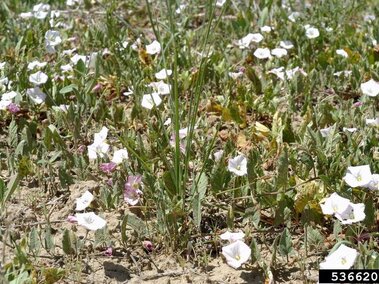
Flowers are bell or funnel-shaped and small, approximately 1 inch in diameter. Flowers can be white or pinkish in color.
Leaves
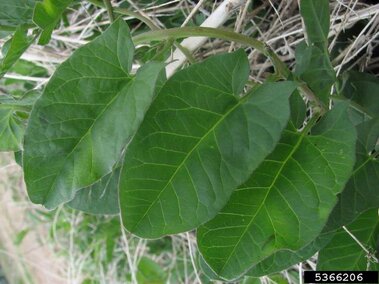
Leaves are alternately arranged and arrowhead-shaped. They have pointed or blunt lobes at the base.
Stems
Stems are like vines, growing along the ground or climbing up structures. Twining stems form dense, tangled mats on the surface.
Seeds
Seeds are ovoid and usually have 1-2 flat sides with 1 rounded side. Seeds are usually smaller than 1/4 inch.
Photos
Where Does It Grow?
Field bindweed grows in pastures, agricultural areas, roadsides, lawns, and gardens. It is drought tolerant and can grow in full sun or full shade. It can be found throughout the United States and southern Canada. It is established in Nebraska.
How Does It Spread?
Field bindweed was first documented in North America in the mid-1700s and was likely introduced in contaminated crop seed. This plant spreads through seed or through its creeping root system, which can produce new plants. Seeds can be dispersed via natural vectors or human vectors, such as by harvesting equipment or contamination of crop seed. Seeds can remain viable for more than 50 years.
How Do I Control It?
Field bindweed is nearly impossible to eradicate once it has been established. Effective control will take place over multiple years and requires a integrated pest management plan that prevents seed production, tillage of the root system, resource competition, and vigilance in removing top growth.
Mechanical
Mechanical controls do not have a significant effect, as the plant must be removed by the root system which is extensive and can extend up to 20 feet into the ground.
Contact your county weed control authority to determine appropriate removal methods.
Cultural
Planting tall, shade-producing crops or vegetation can help reduce field bindweed, as it is less competitive in shady conditions. Additionally, planting a dense, healthy plant community can help prevent infestations.
Minimize overgrazing, as bare spots can be prime locations for field bindweed infestation. Use only certified weed-free hay.
One way that invasive plant seeds and fragments can spread is in soil and through seed transport by people. You can help prevent invasive plant spread in a few simple steps:
REMOVE plants, animals and mud from boots, gear, pets and vehicles.
CLEAN your gear before entering and leaving the recreation site.
STAY on designated roads and trails.
PLANT non-invasive species.
PlayCleanGo: Stop Invasive Species in Your Tracks
Herbicide
Please refer to the 2026 Guide for Weed, Disease and Insect Management in Nebraska and/or contact your county weed control authority.
References and More Information
Colorado Department of Agriculture
Montana State University Extension
Nebraska Weed Control Association
Nebraska Weed Free Forage Program
North American Invasive Species Management Association Fact Sheet
North Carolina State University Extension Gardener
Stubbendieck, J., Coffin, M., & Dunn, C. (2019). Weeds of the Great Plains. Nebraska Department of Agriculture.
University of California Statewide Integrated Pest Management Program