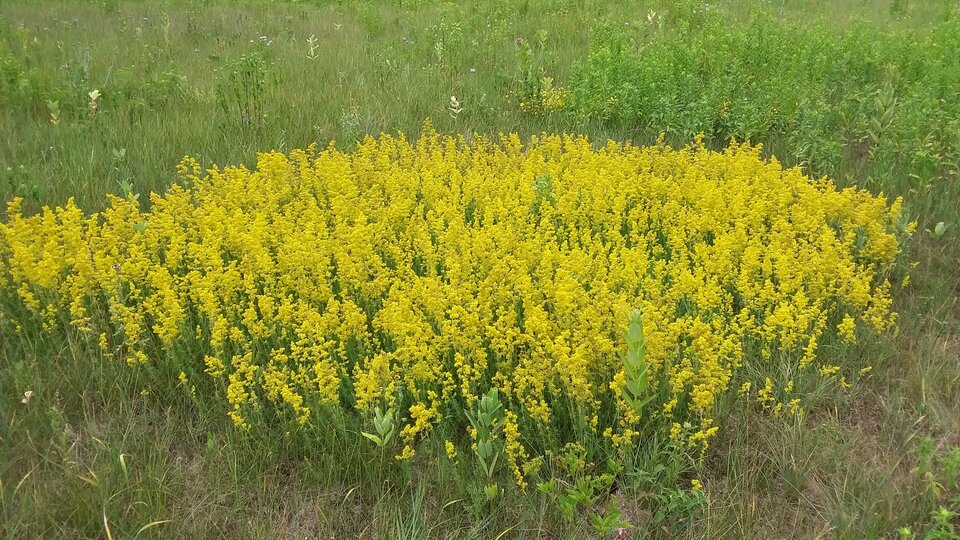
Credit: Ann Danielson, Bugwood.org
General Information
Species Name: Galium verum
Also Known As: lady's bedstraw, maiden's hair, fleaweed, cheese rennet
Family: Rubiaceae (Madder)
Growth Form: Forb
Life Span: Perennial
Flowering Dates: May-August
Origin: Europe
Noxious: Yes. Yellow bedstraw is listed as a County Designated Noxious Weed for Cherry County. Please report to the local weed control authority if found in the following counties: Cherry.
Why Is It Invasive?
Yellow bedstraw invades sunny areas, such as field, pastures, and roadsides, outcompeting native and desirable forage species.
What Does It Look Like?
General Characteristics
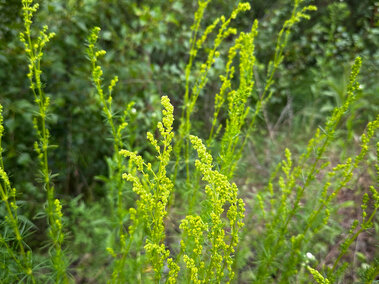
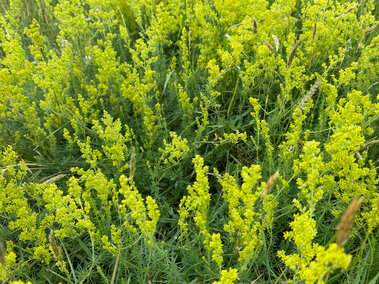
Yellow bedstraw can grow up to 4 feet tall, is highly branching, and has bright yellow flowers. It may have a vanilla or honey scent.
Flowers
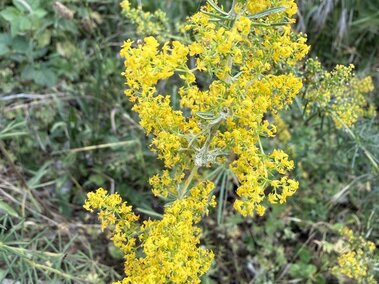
Flowers are small, yellow, and clustered. Flowers usually have four petal that are pointed or blunt tipped. May be honey or vanilla scented.
Leaves
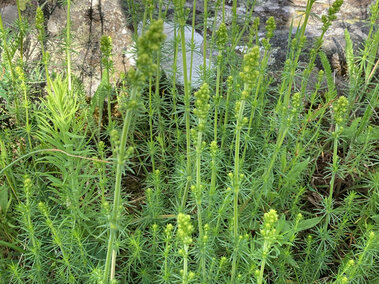
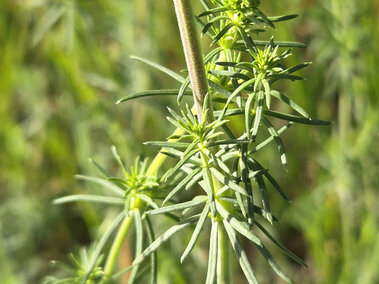
Leaves are whorled in groups of 6-12, narrow, and sometimes slightly rolled. Leaves are covered in short hairs and have sharply pointed tips.
Stems
Stems are erect or sprawling, with frequent rooting occurring where nodes touch the ground. The Lower parts of the stem are four sided with rounded angles. Stems are usually covered in small hairs.
Seeds
Small, brown
Photos
Where Does It Grow?
Yellow bedstraw can be found in dry, sunny areas such as ditches, meadows, pastures, and can quickly invade disturbed sites. It is widely distributed across the United States.
How Does It Spread?
Yellow bedstraw reproduces both by seed and vegetatively by rhizomes. It was initially introduced to North America to be cultivated for a wide variety of uses (stuff mattresses, repel insects, add color to cheese, and medicinal), but escaped captivity.
How Do I Control It?
Mechanical
Mowing will reduce seed production and provide some control, but will not eradicate infestations. Pulling or digging small infestations may be successful if done carefully, ensuring that the entire root system and root fragments have been removed.
Contact your county weed control authority to determine appropriate removal methods.
Cultural
Prevent seed spread after outdoor activities in a few simple steps:
REMOVE plants, animals and mud from boots, gear, pets and vehicles.
CLEAN your gear before entering and leaving the recreation site.
STAY on designated roads and trails.
PLANT non-invasive species.
PlayCleanGo: Stop Invasive Species in Your Tracks
Chemical
Please refer to the 2026 Guide for Weed, Disease and Insect Management in Nebraska or contact your county weed control authority.
What Should I Do If I See It in Nebraska?
If you see yellow bedstraw in Nebraska, you should report it to your county weed control authority. For guidance on what information to include in your report, check out our reporting tips.
References and More Information
Nebraska County Designated Noxious Weeds
Nebraska Weed Control Association