General Information
Species Name: Reynoutria japonica
Also Known As: fleeceflower, Mexican bamboo, huzhang
Family: Polygonaceae (Buckwheat)
Growth Form: Forb
Life Span: Perennial
Flowering Dates: July - October
Origin: Asia
Noxious: Yes. Japanese knotweed is listed as a State Noxious Weed under the Noxious Weed Control Act in Nebraska, which means it is required by law for it to be removed from public and private land in the state.
Category 4: Noxious Aquatic Invasive Species
Why Is It Invasive?
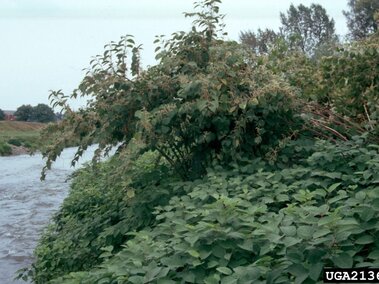
Japanese knotweed forms dense thickets that crowd out native vegetation, can block small waterways and contribute to bank erosion, and can penetrate asphalt and concrete, causing cracking. It can also hybridize with invasive giant knotweed, forming fertile offspring. It reproduces vegetatively via rhizomes that can expand quickly.
What Does It Look Like?
General Characteristics
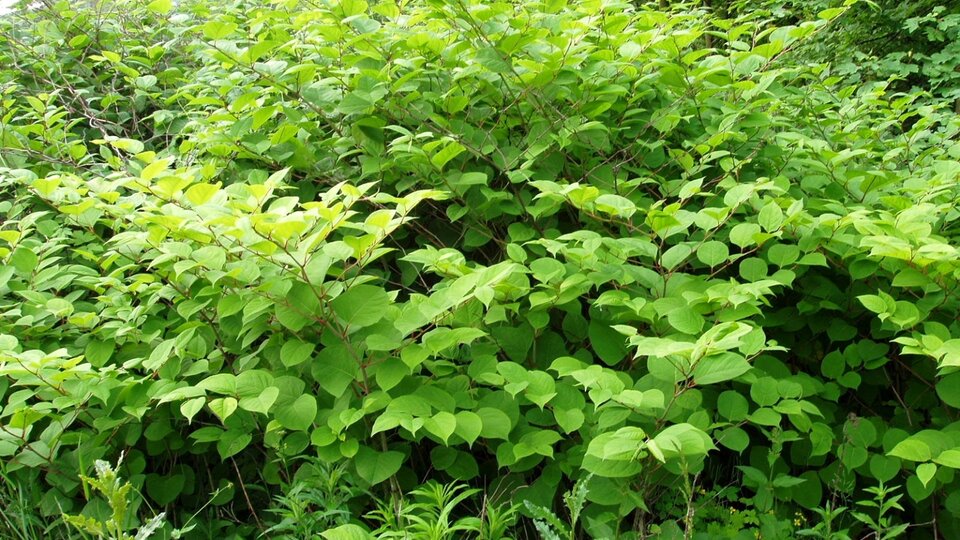
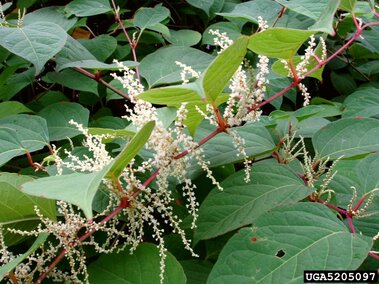
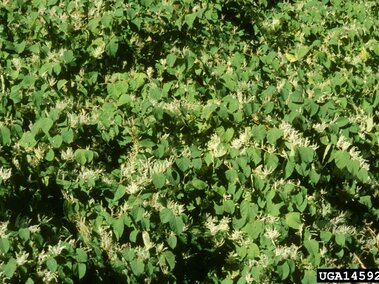
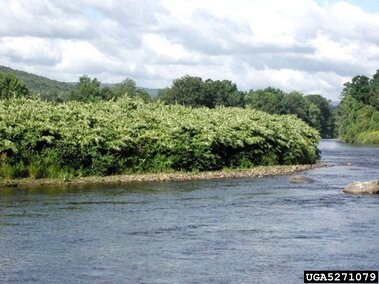
Japanese knotweed is a woody, upward growing plant with white flowers that forms dense stands.
Flowers
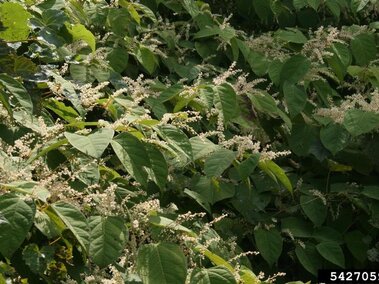
Small white to green-white flowers that grow in clusters at the end of the leaves.
Leaves
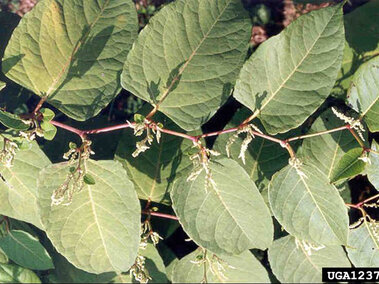
Leaves are alternately arranged and are oval or triangular with a defined pointed tip. Leaves are broad and 10-17cm long and 7-10cm wide.
Stems
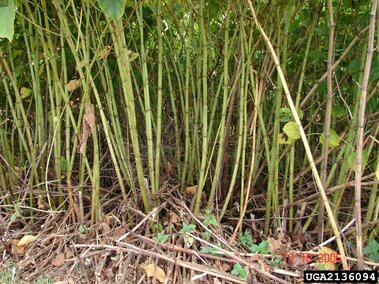
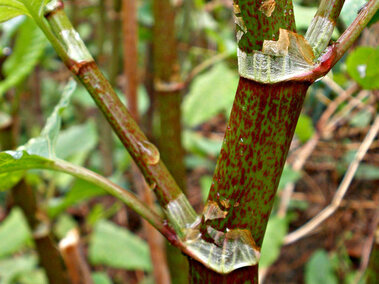
Stems are hollow, smooth, and purple to green colored. Stems have a fine whitish coating that rubs off easily. Smaller branches have a signature zig-zag shape.
Seeds
Winged, triangular, shiny, and very small.
Photos
Where Does It Grow?
Japanese knotweed has spread throughout much of the United States. It will invade areas with full or mostly full sunlight, such as roadsides or meadows, as well as riparian areas. Japanese knotweed is tolerant of drought, high temperatures, and high salinity. It has been known to grow through cracks in cements, stone walls, or between floorboards.
How Does It Spread?
Japanese knotweed can spread by seed by primarily spreads vegetatively through expansive underground root systems, where as much as 2/3 of the plants biomass resides. It can also spread through stem and leaf fragments, with small pieces of the plant sprouting entire colonies. Japanese knotweed was initially brought to the United States in the 1800s as an ornamental plant.
How Do I Control It?
A combination of methods is required for controlling Japanese knotweed, with special focus on targeting its underground rhizome system. A long-term management plan in which known populations are monitored and vigilance in sighting new stands is vital.
Mechanical
Mechanical removal of Japanese knotweed is difficult due to its extensive underground root system.
Contact your county weed control authority to determine appropriate removal methods.
Cultural
Do not use Japanese knotweed for ornamental purposes. Be sure to avoid moving contaminated soil and check clothes, pets, and equipment for plant fragments after being in an infested area.
Chemical
Please refer to the 2026 Guide for Weed, Pest, and Insect Management in Nebraska or contact your county weed control authority.
What Should I Do If I See It in Nebraska?
If you see Japanese knotweed in Nebraska, you should report it to your county weed control authority. For guidance on what information to include in your report, check out our reporting tips.
References and More Information
Michigan Department of Natural Resources
National Invasive Species Information Center