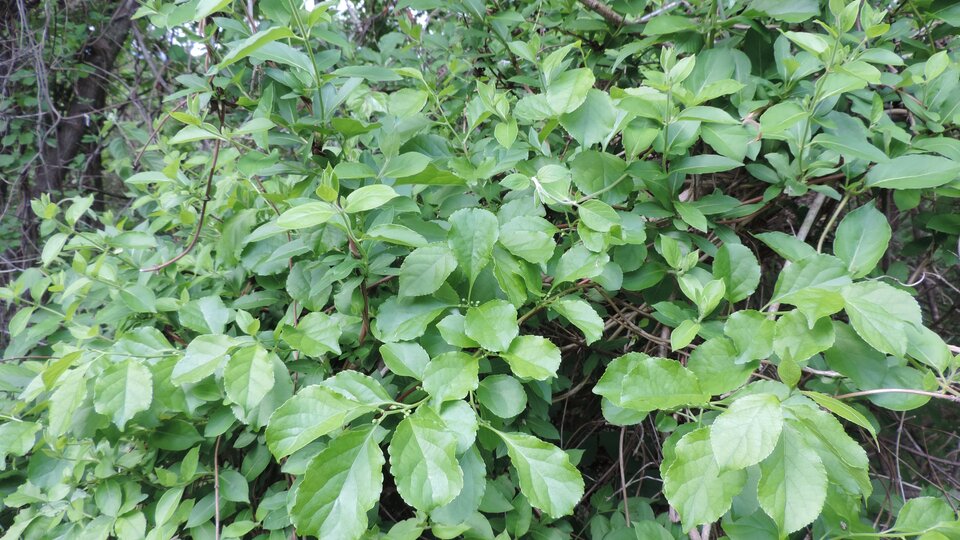
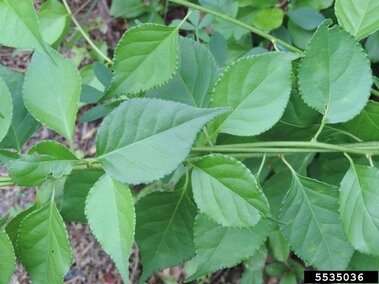
Credit: Richard Gardner, Bugwood.org
General Information
Species Name: Celastrus orbiculatus
Also Known As: climbing spindleberry, staff vine, Oriental bittersweet, Oriental staff vine, Asiatic bittersweet
Family: Celastraceae (Bittersweet)
Growth Form: Vine
Life Span: Perennial
Flowering Dates: Spring
Origin: Eastern Asia
Noxious: No
Why Is It Invasive?
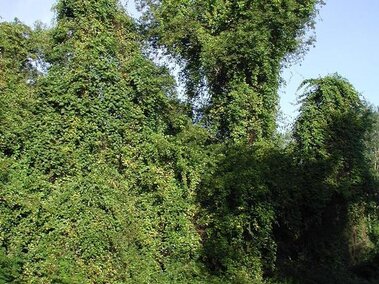
Round leaf bittersweet is a creeping vine that smothers and strangles trees and forests. It dominates tree canopies and reduces light and moisture for lower canopy vegetation.
What Does It Look Like?
General Characteristics
Round leaf bittersweet is a woody vine that is light brown to gray in color. It grows horizontally or vertically and can grow longer than 60 feet.
Flowers
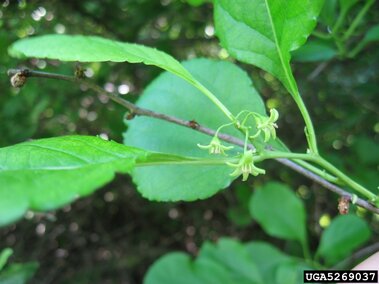
Flowers are small (less than 1cm wide), white to pale green or yellow and have 5 petals. Flowers are in clusters of 2-7. There are separate male and female plants with white pollen on the male plants.
Leaves
Leaves are alternately arranged and are oblong to nearly round. Leaves can be 2-5 inches long and 1.5 - 2 inches wide and margins have rounded teeth. Leaves are green and turn yellow in the fall.
Stems
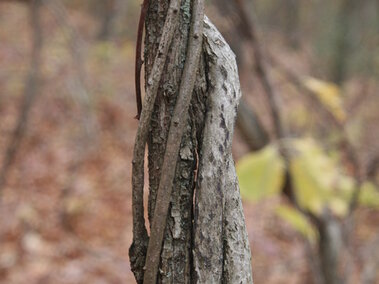
Woody vines are grayish-brown and can grow upwards of 60 feet long. Vines climb by winding around trees and other support structures. Whitish, raised pores can occur on the vine.
Seeds
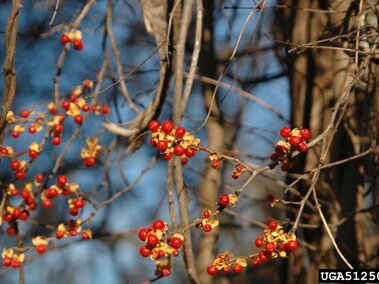
Loose bunches of 3-7 yellow capsules are strung along the stem in which red berries are enclosed. Capsules are 3-parted. Berries have three segments, each containing 1-2 seeds. Berries can persist throughout the winter.
Photos
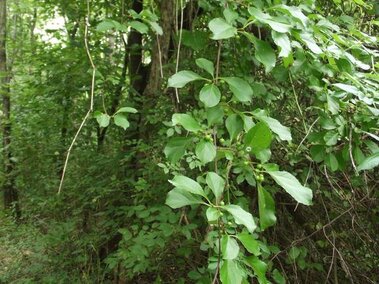
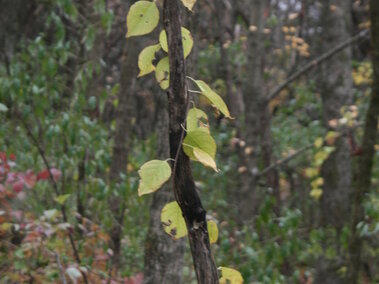
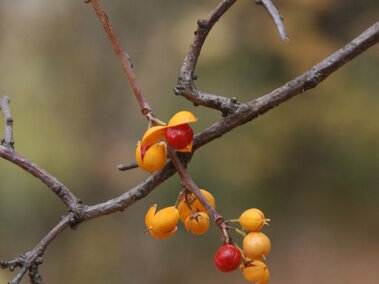
Where Does It Grow?
Round leaf bittersweet thrives in a wide variety of soil types and can succeed in full sun to shade. It is often found in forested areas, meadows, fence rows, along waterways, and in residential landscapes.
How Does It Spread?
Round leaf bittersweet was initially introduced to North America in the 1860s for ornamental purposes and is currently distributed throughout the northeastern and Midwest United States. Round leaf bittersweet is most commonly spread via seed ingestion and dispersal by birds and mammals. It is sometimes spread by human use in flower arrangements or sometimes mistaken as American bittersweet and sold in nurseries and garden centers.
How Do I Control It?
Sites infested with round leaf bittersweet will require monitoring and treatment repeatedly until the seedbank is depleted.
Mechanical
Mechanical removal is most successful for smaller plants. Seedlings can be removed by hand and weekly mowing can provide control. When round leaf bittersweet vines extend into trees, cutting through the vine can provide temporary control but will ultimately result in resprouting.
Contact your county weed control authority to determine appropriate removal methods.
Cultural
Prevent round leaf bittersweet spread by learning to recognize it and not planting it. Do not use it for ornamental purposes, including in flower arrangements. Utilize native substitutes, such as American bittersweet.
Chemical
Please refer to the 2026 Guide for Weed, Disease and Insect Management in Nebraska and/or contact your county weed control authority.
What Should I Do If I See It in Nebraska?
If you see Round leaf bittersweet in Nebraska, you should report it to your county weed control authority. For guidance on what information to include in your report, check out our reporting tips.
References and More Information
Minnesota Department of Agriculture
Minnesota Department of Natural Resources
National Invasive Species Information Center