
General Information
Species Name: Pueraria montana
Family: Fabaceae (pea)
Growth Form: Vine
Life Span: Perennial
Flowering Dates: Midsummer
Origin: Asia
Noxious: No
Why Is It Invasive?
Kudzu grows rapidly, up to 1 foot daily, and covers nearly anything in a thick blanket of leaves and vines that block out sunlight, smothers native plants, and can cause damage to buildings.
What Does It Look Like?
General Characteristics
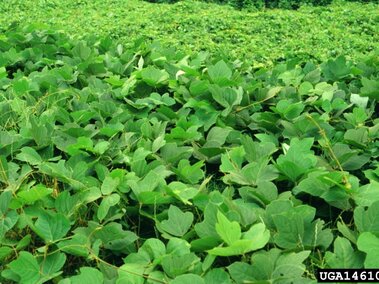
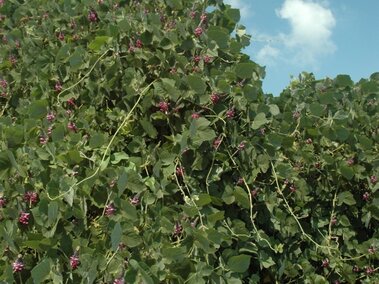
Kudzu is a green, climbing vine that can grow in dense stands on the ground or climb up trees, buildings, and other structures.
Flowers
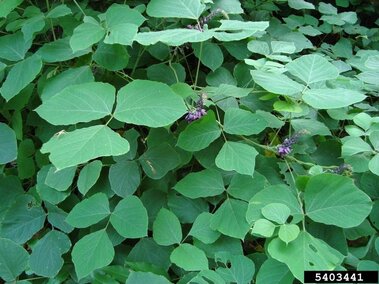
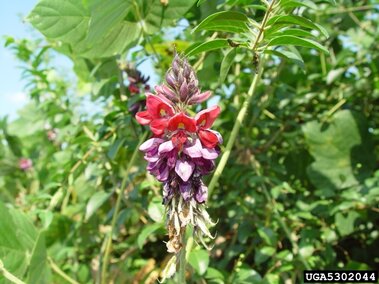
Flowers are small, 1/2 to 3/4 inch, and are purple to purple-red. Flowers grow in bunches.
Leaves
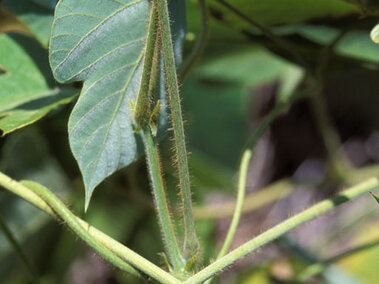
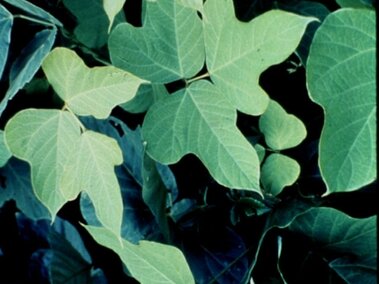
Leaves are 3-4 inches long, dark green, and are oval or heart-shaped. Leaves are alternately arranged and grow in clusters of three leaflets. The underside of the leaf is hairy.
Stems
Vines are woody, slightly hairy, and grow in all directions. Vines can grow upwards of 90 feet.
Seeds
Seedpods are flattened, brown, hairy, and approximately 2 inches long. Seedpods typically form on the upwards climbing vines.
Photos


Where Does It Grow?
Kudzu has been documented in the South, East Coast, and southeast Great Plains, as well as Oregon and Washington. Kudzu is nicknamed "the vine that ate the south" due to its widespread infestations in the Southern United States. It thrives in full sunlight, growing along forest edges, open fields, roadsides and highways. Kudzu can grow in a wide range of conditions and soil types.
How Does It Spread?
Kudzu was initially introduced as a forage crop and ornamental plant in the late 1800s, and planting was encouraged to prevent erosion control in the early-mid 1900s. Kudzu primarily spreads through runners, rhizomes, or vines that root at the nodes. As many as 30 vines can grow from a single root crown.
How Do I Control It?
A combination of control methods is recommended for kudzu management. Acting quickly in cases of small infestations is essential. Creating a long-term plan is important, as it can take several years to eradicate well-established kudzu.
Mechanical
Mowing repeatedly can eventually kill kudzu, but it must be ongoing for total eradication. Removing the crown and ensuring that all anchored points of the vine have been removed is effective, but labor intensive.
Contact your county weed control authority to determine appropriate removal methods.
Cultural
Do not plant invasive plants for either ornamental or grazing purposes, instead plant native species.
Livestock grazing can be an effective control method.
Chemical
Please refer to the 2026 Guide for Weed, Disease and Insect Management in Nebraska and/or contact your county weed control authority.
What Should I Do If I See It in Nebraska?
If you see Kudzu in Nebraska, you should report it to your county weed control authority. For guidance on what information to include in your report, check out our reporting tips.
References and More Information
Mississippi State University Extension
Nebraska Weed Control Association