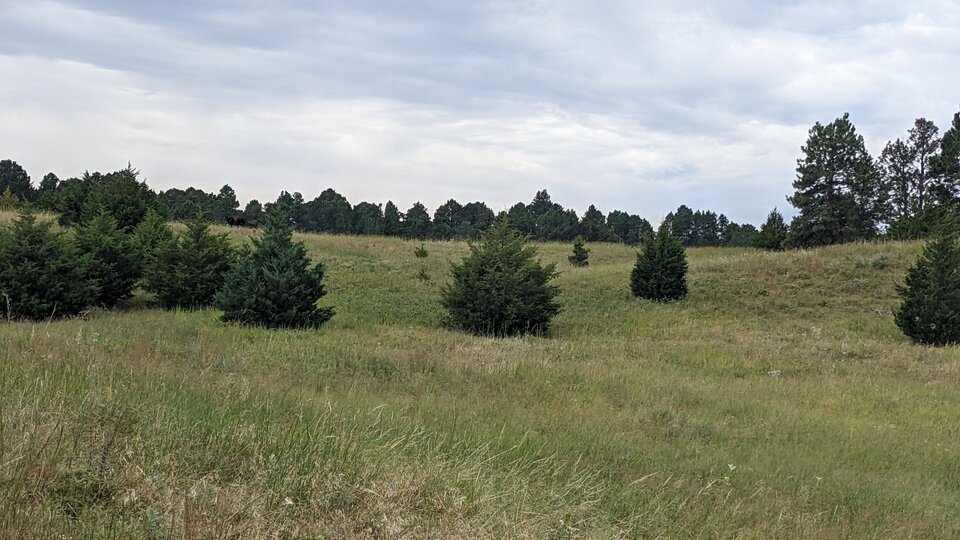
Credit: Shannon Smith, Nebraska Invasive Species Council
General Information
Species Name: Juniperus virginiana
Also Known As: Carolina cedar, eastern red cedar, juniper, pencil cedar, red cedar, red juniper, red savin, savin, Virginia juniper
Family: Cuppressaceae (Cypress)
Growth Form: Tree
Life Span: Perennial
Flowering Dates: March-May
Origin: Native
Toxic: Yes, consumption of its foliage by cattle has been reported to infrequently cause abortions
Noxious: No
Why Is It Problematic?
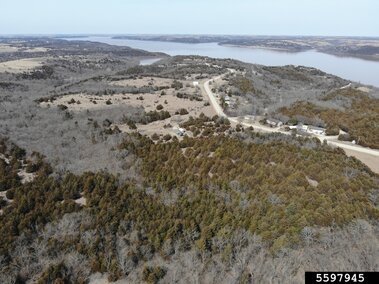
While extremely drought tolerant, it is intolerant of both shade and fire and historically it was mostly restricted to sparsely vegetated, open, fire protected margins of slopes, bluffs and rock outcrops. It is also long-lived, some specimens four centuries or older in age. With the absence of fire in the present time, it has become common across the landscape in open, dry habitats from abandoned fields and pastures to open rolling and steep goat prairies. It can readily invade even high quality native prairie, eventually creating a closed canopy that chokes out ground layer species.
Once it takes over an area, rangeland productivity decreases by 75 percent, as the trees strip forage grasses of necessary sunlight and water. And once rangeland has been compromised by eastern redcedar, removal can cost up to $150 per acre in the Sandhills, the equivalent of $150,000 to treat just 1,000 acres. Costs are even higher in southwestern Nebraska where even more trees are established.
What Does It Look Like?
General Characteristics
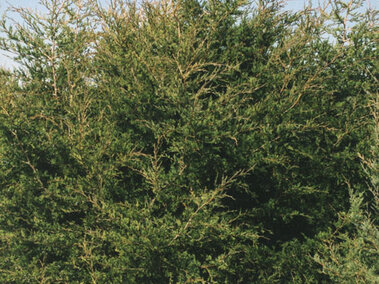
Eastern redcedar is a small to mid-sized, conical shaped evergreen tree and is not a true cedar at all, but a juniper.
Flowers
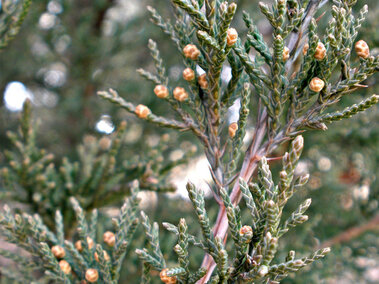
Male and female flowers are cone like structures called strobili, borne on separate trees. Male cones are oval to egg shaped, 1/8 to 1/6 inch long with yellowish brown scales holding the yellow pollen, at the tips of 2nd year branches.
Female flower cones appear as several ranks of yellowish-tan to blue-green scales at branch tips, little more than 1/16 inch long.
Leaves
Leaves are of two kinds. Leaves on older, slower growing twigs are lance-oval, scale-like tapering to a pointed tip, crowded together in opposite pairs, overlapping and tightly appressed to the branch, 1/10 inch long or less (1-3 mm).
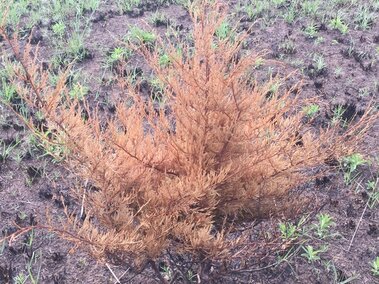
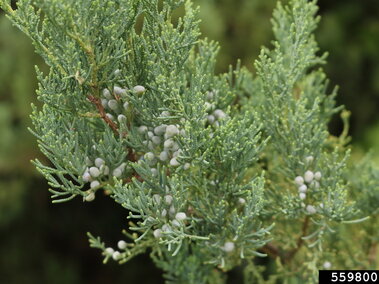
Leaves on young, fast growing branches are awl-like, up to 1/3 inch long, spaced some distance apart, opposite or in whorls of three, with the sharp tip spreading making them very prickly. Early season the foliage turns green but by late summer and through winter, turns a dark bronzy red, often with a waxy bloom. Leaves can persist 4 to 6 years.
Stems
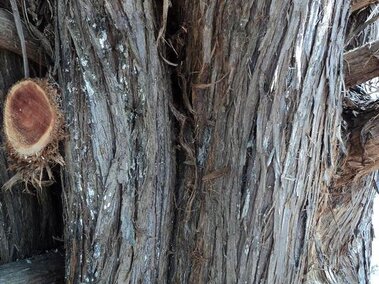
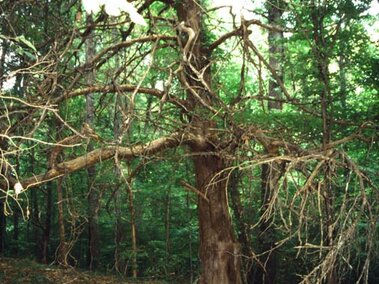
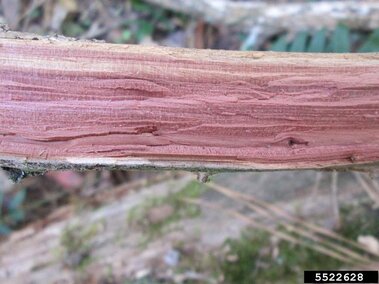
Trunks are up to 20 inches in diameter. Older bark is thin, grayish brown in long, thin and flattened vertical ridges that peel off in long stringy strips over time. Branchlets on fast juvenile growth are long, thin and straight, on older growth they are short and much divergent, forming branched coral-like clusters at branch tips.
Seeds
Fruit is an irregularly round berry-like cone, up to ¼ inch diameter with a waxy bluish coating similar to blueberries. Immature cones are fleshy becoming dry and pithy.
A cone contains 1 to 3 seeds; seeds are irregularly egg-shaped and remain within the closed cone until dispersed by animals.
Photos
Where Does It Grow?
Eastern redcedar is a native tree that has long been used in windbreaks, shelterbelts, and conservation plantings across the Great Plains. It tolerates just about any type of soil (fertile, sterile, clay, sandy, thin, or rocky) and non-wet moisture condition (very dry, dry, or moist but well-drained) and adapts well to neutral or acidic soils. It thrives and out-competes most other woody plants in rocky, alkaline, dry soils, especially in full sun to partial sun conditions with minimal soil fertility. It thrives on neglect, and is a good "cover crop" for recently cleared ground, helping to minimize long-term erosion on barren hillsides with its quick establishment under harsh conditions. It can also thrive in the smog, reflected light, and intense heat found in large cities. It grows in full sun to partial sun, and is found in zones 4 to 9. Redcedar grows faster than most other junipers and is moderately long-lived. Plans for long-term management of new seedling growth must be developed.
How Does It Spread?
The fruit is a favorite of numerous birds and other animals which accounts for its spread to areas where it is not wanted. Red cedar and other junipers are important to wildlife throughout the country. Winter food and protection is particularly important for pheasant, mule deer, and whitetail deer. Their twigs and foliage are eaten extensively by hoofed browsers, but the chief attraction to wildlife is the bluish-black berry-like fruit. The cedar waxwing is one of the principal users of red cedar berries, but numerous other birds and mammals, both large and small, make these fruits an important part of their diet. In addition to their wildlife food value, cedars provide important protective and nesting cover. Chipping sparrows, robins, song sparrows, and mockingbirds use these trees as one of their favorite nesting sites. Juncos, myrtle warblers, sparrows of various kinds, and other birds use the dense foliage as roosting cover. In winter, their dense protective shelter is especially valuable.
Changes in land management over several decades allowed eastern redcedar to escape its typical habitat and move rapidly into grasslands and riparian forests. The tree still possesses benefits for multi-row or single-row windbreak plantings. However, landowners must plan to actively manage new seedling growth on their property for the life of the planting.
How Do I Control It?
Mechanical
Using prescribed fire, grasslands are best managed with low populations of cedar of small size. Grasslands with heavy cedar fuel loads and large trees can be challenging to bum safely, and remaining cedar skeletons still need to be mechanically removed post-fire. Forests (especially ponderosa pine forests) with cedar in the understory often cannot be safely burned at all until the cedar understory is mechanically removed. Current average costs for mechanical removal range from $120/acre to $1,000/acre depending on tree density, size, plant community, soil type, and topography.
Contact your county weed control authority to determine appropriate removal methods.
Cultural
For numerous Native American Tribes, the red cedar tree symbolizes the tree of life and is burned in sweat lodges and in purification rites. The distilled oil of the red cedar has been officially listed as a reagent in the U.S Pharmacopoeia since 1916.
One way that invasive plant seeds and fragments can spread is in soil. Sometimes plants are planted purposefully. You can prevent the spread of invasive plants.
PlayCleanGo: Stop Invasive Species in Your Tracks
REMOVE plants, animals and mud from boots, gear, pets and vehicles.
CLEAN your gear before entering and leaving the recreation site.
STAY on designated roads and trails.
PLANT non-invasive species.
Herbicide
Please refer to the 2025 Guide for Weed, Disease and Insect Management in Nebraska and/or contact your county weed control authority.
References and More Information
Blum, R. (2020). Halt Eastern Redcedar Invasion. Nebraskaland Magazine. Nebraska Game and Parks Commission.
Center for Invasive Species and Ecosystem Health
Ladybird Johnson Wildflower Center
National Invasive Species Information Center
Nebraska Conservation Roundtable
Nebraska County Designated Noxious Weeds
Nebraska Department of Agriculture
North Carolina State Extension
Ohio Department of Natural Resources
Nebraska Weed Control Association
Nebraska Weed Free Forage Program
Ohio Department of Natural Resources
Stubbendieck, J., Coffin, M., & Dunn, C. (2019). Weeds of the Great Plains. Nebraska Department of Agriculture.