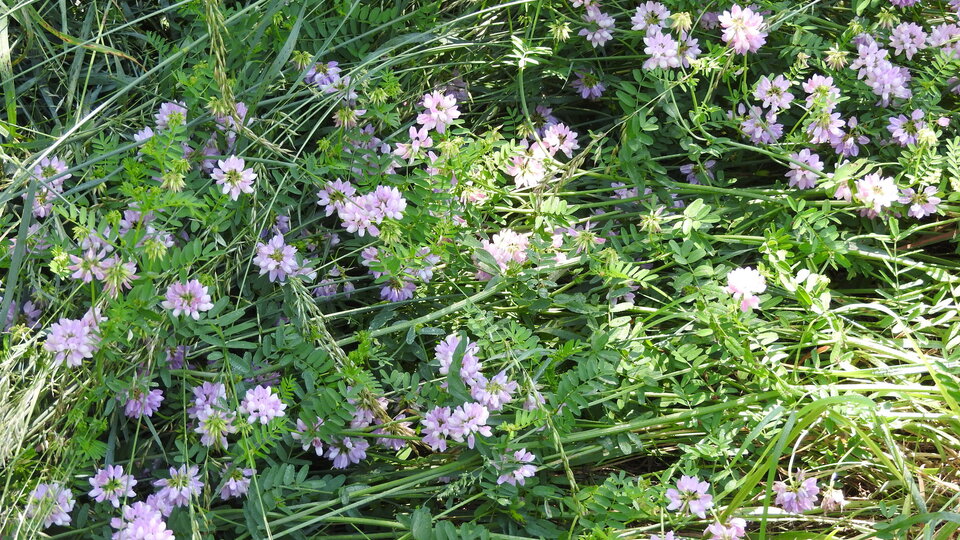
Credit: Richard Gardner, Bugwood.org
General Information
Species Name: Securigera varia
Also Known As: axseed, crown vetch, purple crownvetch, purple crown-vetch
Family: Fabaceae (Bean)
Growth Form: Forb
Life Span: Perennial
Flowering Dates: May-August
Origin: Europe
Toxic: Yes, it is toxic to humans, horses, and other non-ruminants but is tolerated by ruminants with multi-chambered stomachs, such as cattle, goats, and sheep.
Noxious: No
Why Is It Invasive?
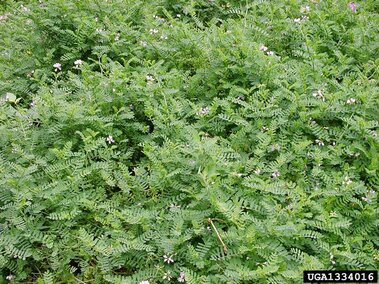
Crownvetch reproduces and spreads rapidly by rhizomes as well as seeds. It forms dense thickets in open, disturbed areas such as fields and roadsides. Once established it is difficult to remove.
What Does It Look Like?
General Characteristics
Crownvetch is a perennial herbaceous plan. Its stems trail over other plants and can grow 2-6 feet long. Crown vetch plants are brown in winter and early spring and can be visible as brown patches on the landscape.
Flowers
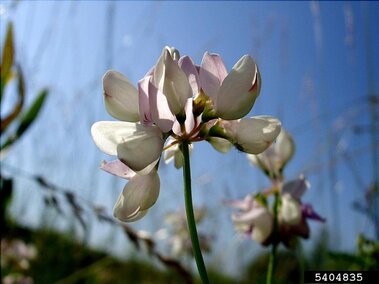
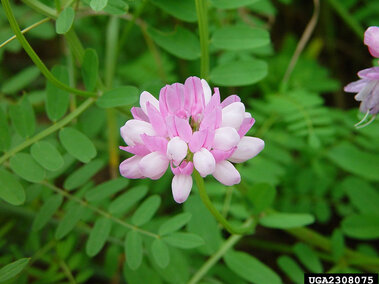
Crownvetch has tubular pink flowers characteristic of plants in the pea family. Flowers are grouped in flat-topped clusters. Flower color can vary from white to pink to lavender. Flowers bloom from May through August.
Leaves
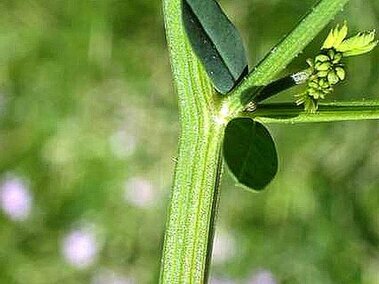
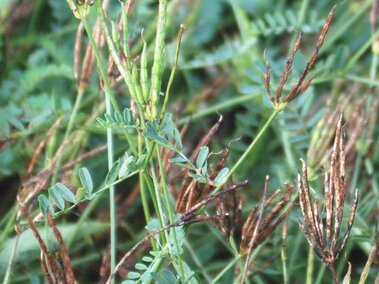
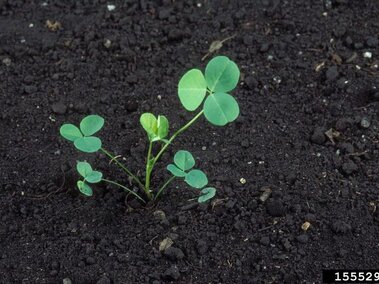
Crownvetch has compound leaves that have 15-25 leaflets with pairs of leaflets along the leaf stalk and one leaflet at the top. Leaflets have smooth edges.
Stems
Crownvetch stems have ridges.
Seeds
Slender seeds are contained in thin, finger-like pods. Seeds can remain viable in the soil for 15 years.
Photos


Where Does It Grow?
It grows in stream banks, roadsides, embankments, fields, and gardens.
How Does It Spread?
Crownvetch was originally cultivated as a ground cover to prevent erosion. It is a quick spreader and can form large masses, creating dense monocultures where little else grows. It spreads both vegetatively through spreading rhizomes and by seed, and is exceedingly difficult to remove once established. It not only invades disturbed areas and roadsides, but also high quality habitat.
How Do I Control It?
Mechanical
Contact your county weed control authority to determine appropriate removal methods.
Cultural
One way that invasive plant seeds and fragments can spread is in soil. Sometimes plants are planted purposefully. You can prevent the spread of invasive plants.
PlayCleanGo: Stop Invasive Species in Your Tracks
REMOVE plants, animals and mud from boots, gear, pets and vehicles.
CLEAN your gear before entering and leaving the recreation site.
STAY on designated roads and trails.
PLANT non-invasive species.
Herbicide
Please refer to the 2025 Guide for Weed, Disease and Insect Management in Nebraska and/or contact your county weed control authority.
References and More Information
Center for Invasive Species and Ecosystem Health
Fire Effects Information System
Global Invasive Species Database
Minnesota Department of Agriculture
Minnesota Department of Natural Resources
National Invasive Species Information Center
Natural Resources Conservation Service
Nebraska County Designated Noxious Weeds
Nebraska Department of Agriculture
Nebraska Weed Control Association
Nebraska Weed Free Forage Program
North Carolina State Extension Gardener
Stubbendieck, J., Coffin, M., & Dunn, C. (2019). Weeds of the Great Plains. Nebraska Department of Agriculture.