General Information
Species Name: Agropyron cristatum and hybrids
Also Known As: crested wheat grass
Family: Poaceae (Grass)
Growth Form: Bunchgrass
Life Span: Perennial
Flowering Dates: June-August
Origin: Eastern Europe, Africa, and Asia
Toxic: No
Noxious: No
Why Is It Invasive?
Crested wheatgrass is cold and drought tolerant with a deep fibrous root system which allows it to compete successfully with both native plants and weeds. It is capable of forming large, monospecific stands that exclude native vegetation and reduce forage diversity.
What Does It Look Like?
General Characteristics
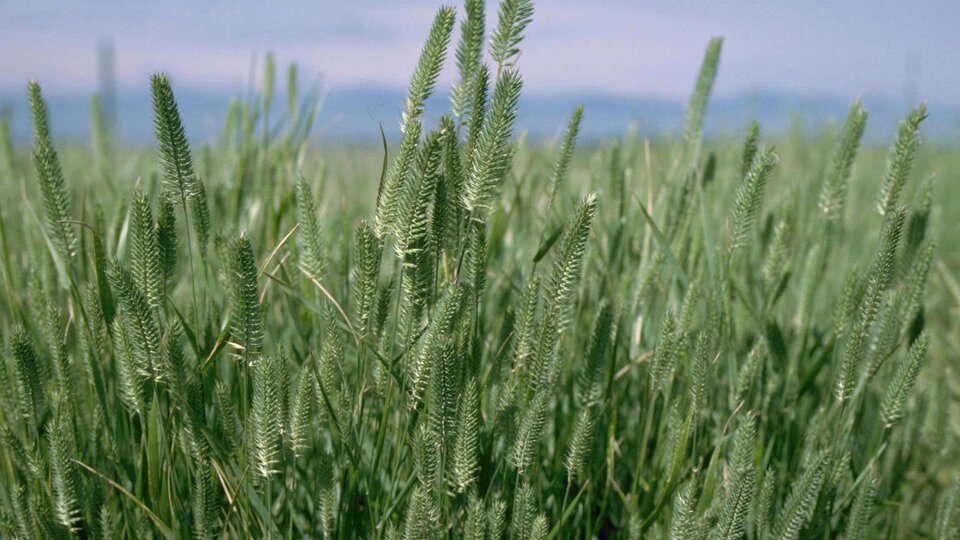
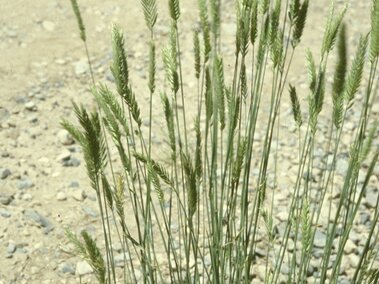
Crested wheatgrass is a cool season perennial bunchgrass that grows from 1-3 ft (0.3-0.9 m) tall.
Flowers
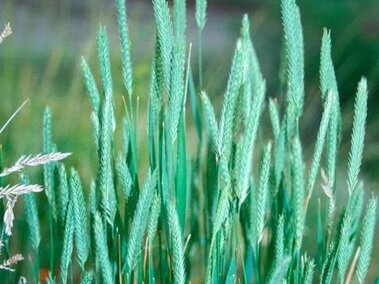
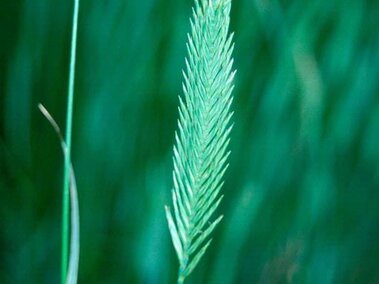
Spike-like cluster at the top of the stem, 1 to 4 inches long, the spikelets (flower clusters) ascending to spreading, alternately arranged on opposite sides of the stalk (2-ranked) and mostly evenly spaced like the teeth of a comb, though the upper spikelets may be more crowded and occasionally spikelets are more irregularly arranged. Spikelets are stalkless or nearly so, light green at flowering time, 7 to 16 mm (to ~2/3 inch) long, flattened, lance-elliptic in outline and have 3 to 6 florets; the floret at the tip may be sterile. The spike stalk (rachis) is often covered in long, appressed hairs.
At the base of a spikelet is a pair of bracts (glumes), both 3 to 6 mm long including a 1 to 3-mm awn, 3-veined, strongly keeled, sometimes with a few long, spreading hairs on the keel, the upper glume usually slightly longer than the lower glume and both shorter than the spikelet. Florets are surrounded by a pair of bracts (lemma and palea), the lemma 5-veined, 5 to 9 mm long including a 1 to 6-mm awn, sometimes with a few long, spreading hairs along the keel; the palea is about as long as the lemma (excluding the awn), 2-veined with a few teeth along the veins.
Leaves
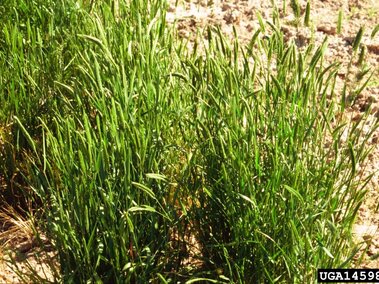
Leaves are alternate, 2 to 5 inches long, 1.5 to 6 mm (to ¼ inch) wide, stiff, flat or rolled in along the edges (involute), hairless to variously hairy. Sheaths are mostly hairless. The ligule (membrane where the leaf joins the sheath) is about 1 mm long and not fringed with hairs. Nodes are smooth.
Stems
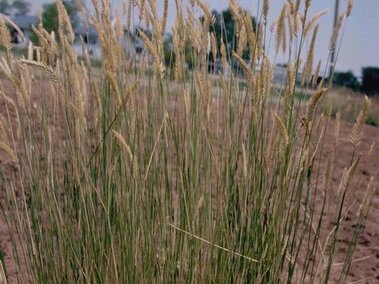
Stems are hairless, erect or sometimes spreading from the base and rising at a lower node (geniculate). Plants are clump-forming but can form dense stands.
Seeds
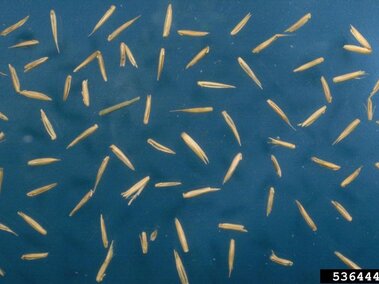
Spikelets are light brown at maturity, the florets shedding individually as each grain matures, leaving the glumes behind on the stalk. Grains (seeds) are oblong and hairy at the tip.
Photos


Where Does It Grow?
Crested wheatgrass is adapted to areas where annual precipitation averages 10 and where the frost free period is generally less than 140 days; it does well up to 9,000 feet elevation. Crested wheatgrass grows on shallow to deep, moderately course to fine textured, moderately well to well drained and weakly acidic to moderately alkaline soils. Under saline conditions, vigor and production are reduced. The cristatum type is not well adapted to silty soils. All crested wheatgrasses are cold tolerant, can withstand moderate periodic flooding in the spring, and are very tolerant of fire. They will not tolerate long periods of inundation, poorly drained soils or excessive irrigation.
How Does It Spread?
It was introduced from Russia into the United States in about 1898, but was not commonly seeded until the 1930s when it was used to stabilize old cultivated fields. It is common in many counties in northern and western Nebraska where it has been seeded for pasture and hay production and was formerly seeded for cover on roadsides. It has several desirable qualities for forage: resilience under grazing pressure, cold and drought tolerant, effective erosion control, and easy to establish.
How Do I Control It?
Mechanical
Contact your county weed control authority to determine appropriate removal methods.
Cultural
One way that invasive plant seeds and fragments can spread is in soil. Sometimes plants are planted purposefully. You can prevent the spread of invasive plants.
PlayCleanGo: Stop Invasive Species in Your Tracks
REMOVE plants, animals and mud from boots, gear, pets and vehicles.
CLEAN your gear before entering and leaving the recreation site.
STAY on designated roads and trails.
PLANT non-invasive species.
Herbicide
Please refer to the 2025 Guide for Weed, Disease and Insect Management in Nebraska and/or contact your county weed control authority.
References and More Information
Center for Invasive Species and Ecosystem Health
Dunn, C. D., Stephenson, M. B., and Stubbendieck, J. (2016). Common Grasses of Nebraska. University of Nebraska-Lincoln Extension.
Natural Resources Conservation Service
Nebraska County Designated Noxious Weeds
Nebraska Department of Agriculture
Nebraska Weed Control Association