
General Information
Species Name: Alopecurus arundinaceus
Also Known As: creeping meadow foxtail
Family: Poaceae (Grass)
Growth Form: Graminoid
Life Span: Perennial
Flowering Dates: May-August
Origin: Eurasia
Toxic: No, but they can be harmful to animals if ingested, inhaled, or embedded. Their seedheads have a sharp bur on one end that allows them to move forward in one direction, making it difficult to get them out if they become stuck in an animal's paw, eyes, ears, nose, mouth, and skin, which can lead to infection and/or other health complications.
Noxious: No
Why Is It Invasive?
Creeping foxtail can spread rapidly, form dense cover, and outcompete other plant species. Once established, it forms a dense mat of roots near the soil surface. Dense cover can impair water movement in canals, irrigation ditches and other waterways.
What Does It Look Like?
General Characteristics
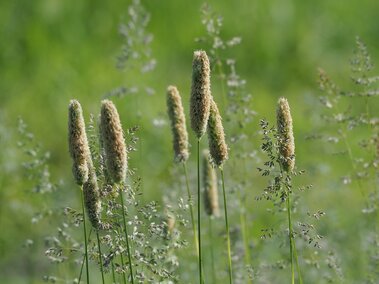
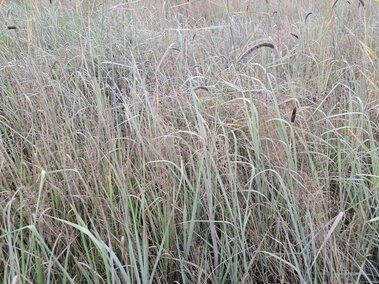
Creeping foxtail is a perennial, cool-season grass well adapted to wet areas. It can grow up to 47 inches tall. It is rhizomatous, meaning it can spread by rhizomes (an underground stem that sends out roots and shoots). Spread by rhizomes can make an existing patch larger. Pieces of rhizomes can also start new plants.
Flowers
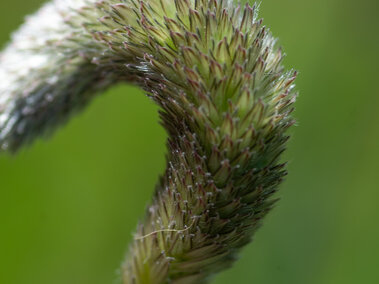
The flower is a spike of small florets. The spike can be 1.5 – 4 inches long and it changes in color from green to deep purple or black as it matures. The florets have 0.01 – 0.08 inch long awns (bristles).
Leaves
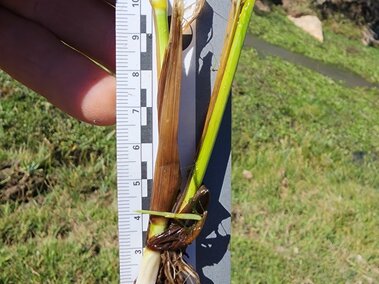
The leaves are 0.2 - 0.3 inches wide. The tops of the leaves are smooth and the bottom side of the leaves are rough.
Stems
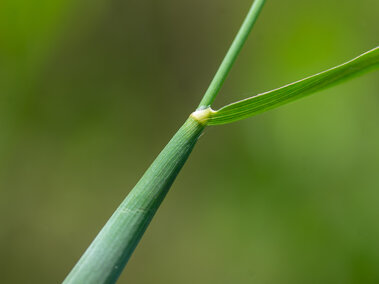
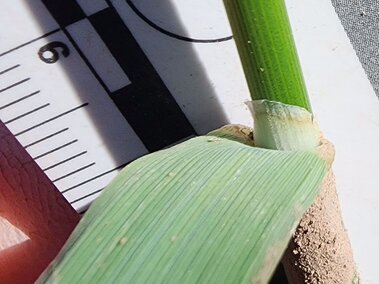
There is a 0.03 - 0.2 inch long ligule (a thin membrane) where the leaf attaches to the stem. Stems can grow up to 47 inches tall.
Seeds
Seeds are 0.05 inches long, black, and covered in small hairs.
Photos


Where Does It Grow?
It grows on wet, saline soils and flood plains along rivers and streams. It adapts well to wet sites, cold environments, and tolerates saline or alkaline soil conditions. Areas that frequently flood and subirrigated ecological sites in the Sandhills are locations where this grass grows well.
How Does It Spread?
The precise date of introduction into the United States is unknown, but it arrived in North Dakota in the early 1900s. It was introduced as a forage crop and is occasionally included in revegetation projects for erosion control.
How Do I Control It?
Mechanical
Contact your county weed control authority to determine appropriate removal methods.
Cultural
One way that invasive plant seeds and fragments can spread is in soil. Sometimes plants are planted purposefully. You can prevent the spread of invasive plants.
PlayCleanGo: Stop Invasive Species in Your Tracks
REMOVE plants, animals and mud from boots, gear, pets and vehicles.
CLEAN your gear before entering and leaving the recreation site.
STAY on designated roads and trails.
PLANT non-invasive species.
Herbicide
Please refer to the 2025 Guide for Weed, Disease and Insect Management in Nebraska and/or contact your county weed control authority.
References and More Information
Dunn, C. D., Stephenson, M. B., and Stubbendieck, J. (2016). Common Grasses of Nebraska. University of Nebraska-Lincoln Extension.
Minnesota Department of Natural Resources
Natural Resources Conservation Service
Nebraska County Designated Noxious Weeds
Nebraska Department of Agriculture
Nebraska Weed Control Association