General Information
Species Name: Dendroctonus ponderosae
Family: Curculionidae (Bark beetles)
Life Cycle: Complete (Egg>Larva>Pupa>Adult); takes approximately 1year to complete life cycle
Activity: Adults emerge in mid-to-late summer and lay eggs in the late summer. Larvae overwinter and pupate early-mid summer.
Origin: Western North America
Host Species: Pine species; preference for lodgepole, ponderosa, western white, sugar, limber, and whitebark pines.
Why Is It Invasive?
Mountain pine beetles invade tree trunks and kill the tree by feeding on it's phloem, cutting of the transport of nutrients within the tree. The beetles also carry blue-stain fungal (Grosmannia clavigerain) spores, which spread rapidly and cut off water transport within the tree. Together, mountain pine beetles and the fungus eventually kill the host tree. This can result in economic damage to forest industries, drastic ecosystem and biodiversity changes, and increased fire hazards.
Mountain pine beetle has expanded its range due to climate change resulting in warmer winters, allowing higher survival rates among individuals. Although the beetles are more likely to attack already stressed trees, an increase in populations has caused them to start attacking healthy trees more regularly, increasing the beetle's detrimental impact.
What Does It Look Like?
Adult Beetle
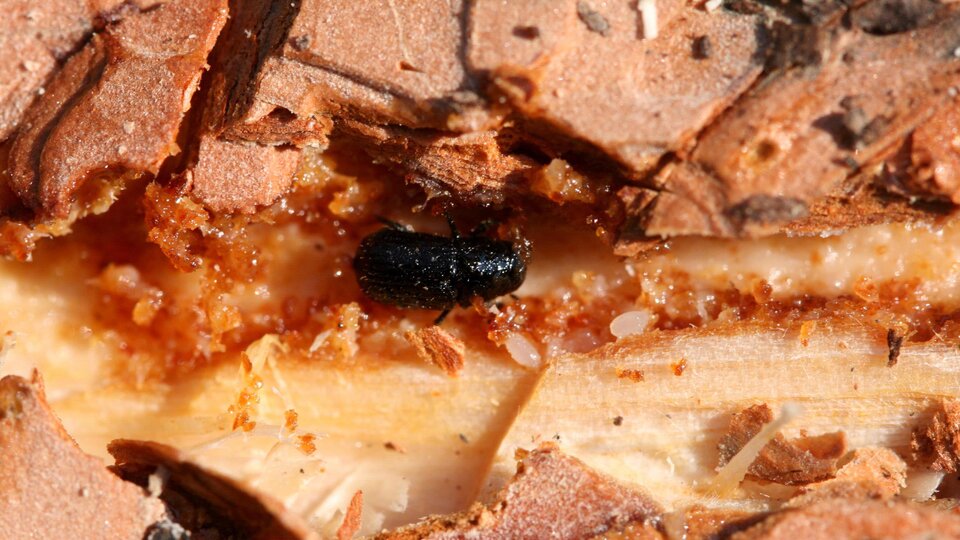
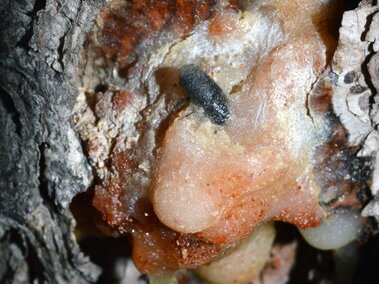
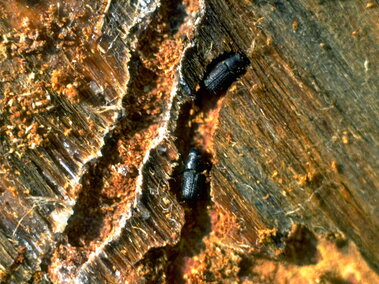
Adults are small (7.5mm long), cylindrical, and have club-like antennae. They are tan in color and turn black as they mature.
Larva
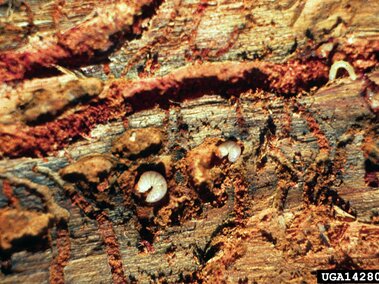
Larvae are white, have red-brown heads, and reach 5mm long in their final molt.
Pupae
Pupae are white and turn light brown, reaching about 5mm long.
Photos
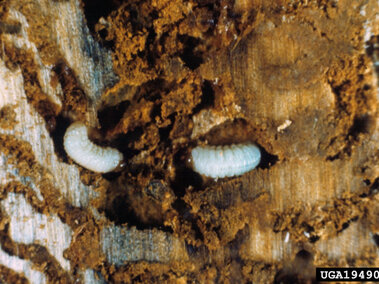
Credit: G.D. Amman, USDA Forest Service, Bugwood.org
Larvae
What Are the Signs of Infestation?
Foliage Damage/Decay
As water conduction up the tree is restricted, foliage will begin to dry, discolor and die. Needles will fall of the tree and the tree will appear gray.
Frass Collection
Frass, a sawdust like material, will collect around the trunk of the tree as the beetles bore through the bark and dig galleries.
Pitch Tubes
Healthy trees will produce a thick resin coating when attacked to deter an infestation. This resin coating collects and is called a pitch tube.
Discolored Wood
Blue-stain fungi introduced by the mountain pine beetle will give the wood a blue-grey appearance as it infests the tree.
Photos
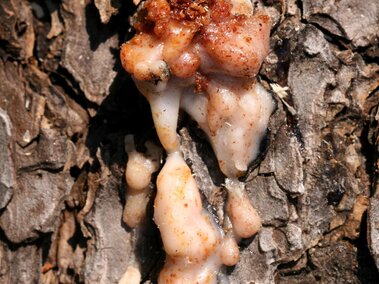
Credit: Whitney Cranshaw, Colorado State University, Bugwood.org
Pitch tube
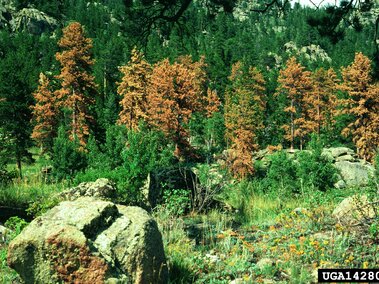
Credit: William M. Ciesla, Forest Health Management International, Bugwood.org
Discolored/dying foliage
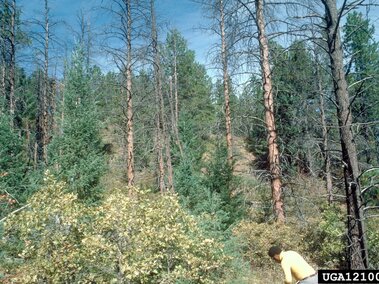
Credit: Dave Powell, USDA Forest Service (retired), Bugwood.org
Dead/dying pine trees with no foliage
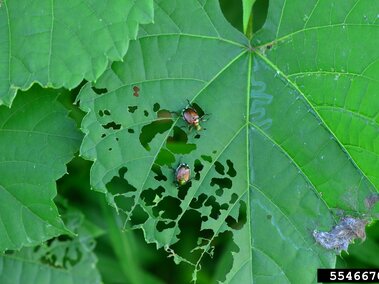
Credit: David L. Clement, University of Maryland, Bugwood.org
Leaf skeletonization
Where Do They Live?
Mountain pine beetles have expanded their range from Western North America into the east as far as the Great Plains region. They can be found wherever their host species, pine trees, are including in rural and urban areas.
How Do They Spread?
Mountain pine beetles have successfully expanded their range naturally due to increasing temperatures across the region. They also "hitchhike" on firewood, lumber, and plant parts.
How Do I Control Them?
Once mountain pine beetles have infested a tree, there is no treatment method to save the tree. Contact a Nebraska Forester for further information on mountain pine beetle control methods.
Cultural
Practice good silviculture practices to reduce tree stress and minimize effects of mountain pine beetle. Develop landscapes with diverse tree species, ages, and size classes.
Do not move or transport firewood long distances and burn it where you buy it. Inspect pine materials for signs of infestation before transporting them.
Insecticide
Please refer to the 2026 Guide for Weed, Disease and Insect Management in Nebraska.
References and More Information
Colorado State University Extension
Minnesota Department of Agriculture
South Dakota Department of Agriculture and Natural Resources