General Information
Species Name: Halyomorpha halys
Family: Pentatomidae (stink bugs)
Life Cycle: Egg > Nymph (5 molt stages) > Adult; 1-2 generations per year
Activity: Adults overwinter beginning in September through October and reappear late next spring
Origin: Asia
Host Species: Many, including fruits, vegetables, crops, and ornamental plants and weeds
Why Is It Invasive?
Brown marmorated stink bug can cause significant agricultural damage as well as pose a human health hazard and nuisance. Brown marmorated stink bug feeds on multitudinous host plants, including fruits, vegetables, crops, and many plants and weeds. Consumption of crops and fruits by brown marmorated stink bugs can make them unmarketable, causing significant economic loss. Brown marmorated stink bug can cause mild allergic reactions to those sensitive to the bug's defensive chemicals and can cause dermatitis in some individuals when they are smashed against the skin. Their defensive chemicals cause an offensive odor, which can also be a nuisance or inconvenience and make areas unpleasant for human occupancy.
What Does It Look Like?
Adult
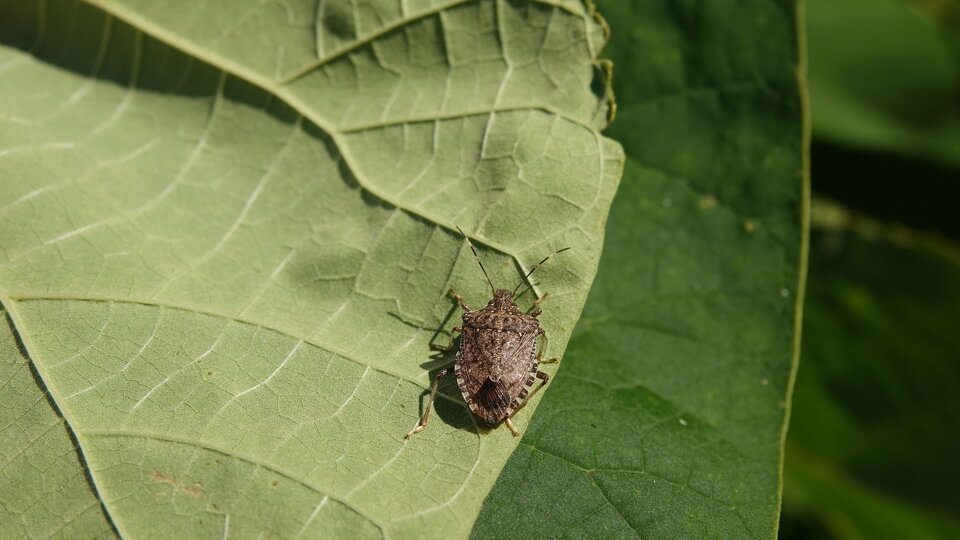
Adults are shield-shaped and roughly the size of a dime. They are marbled brown in color.
Nymph
Nymphs have dark red eyes and yellow abdomens that are mottled with black and red. As they mature, they become darker black and have white bands on the legs and antennae.
Eggs
Eggs are elliptic shaped and light green or yellow. They are grouped in clusters of 20-30 and can be found on the undersides of leaves.
Photos
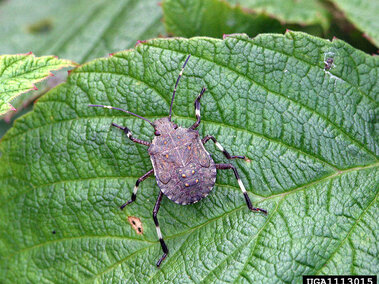
Credit: Gary Bernon, USDA APHIS, Bugwood.org
Adults
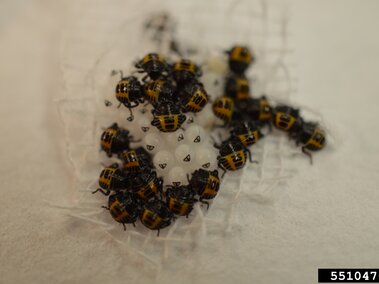
Credit: Brian Little, The University of Georgia, Bugwood.org
Nymphs
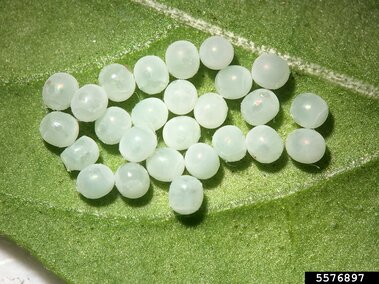
Credit: Gary Bernon, USDA APHIS, Bugwood.org
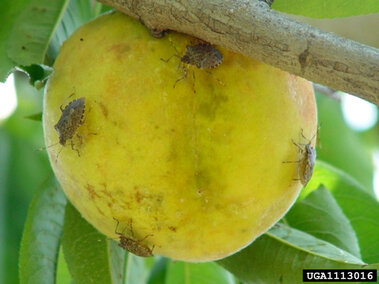
Adults feeding on fruit, resulting in cat-facing
What Are the Signs of Infestation?
Egg Clusters
Small groups of green or yellowish egg clusters can be found on the underside of plant and tree leaves.
Cat Facing
Distortion caused by stink bugs feeding on fruits and other crops which results in scarring, spongy spaces, sunken areas, and deformed pods.
Photos
What Are the Signs of Infestation?
Egg Clusters
Small groups of green or yellowish egg clusters can be found on the underside of plant and tree leaves.
Cat Facing
Distortion caused by stink bugs feeding on fruits and other crops which results in scarring, spongy spaces, sunken areas, and deformed pods.
Where Do They Live?
Brown marmorated stink bugs can be found anywhere where their host species are present. They are widely distributed across the United States.
How Do They Spread?
Brown marmorated stink bug was initially introduced to North America from Asia in the mid 1990s. It is suspected that they "hitchhiked" in a shipping container. They have since spread via natural and human-led expansion.
How Do I Control Them?
Mechanical
Locate areas of homes and buildings that have openings, such as around windows, doors, and screens, and utilize caulking or foam sealant to seal these areas and prevent brown marmorated stink bugs from entering. Turn off unnecessary lights when entering or exiting a home, as they are often attracted to slights and will flood lights in large numbers at dark. Cover vegetables and gardens with row cover or other light, permeable material to help prevent brown marmorated stink bugs from feeding on plants.
If brown marmorated stink bugs are already present in a home or building, use a vacuum to remove live and dead bugs. However, the canister may smell offensively for a period of time. Trap bugs by filling a metal pan with soapy water and position a light source above it. Empty the pan frequently.
Cultural
Brown marmorated stink bugs can be moved by "hitchhiking" on vehicles, outdoor gear, and other equipment. Inspect gear and equipment before moving from one area to another for signs of brown marmorated stink bugs. Regularly monitor structures, agricultural areas, and gardens for signs of infestation.
Insecticides
Please refer to the 2026 Guide for Weed, Disease and Insect Management in Nebraska.
References and More Information
Michigan State University Extension
Minnesota Department of Agriculture
National Invasive Species Information Center
Pennsylvania State University Extension
Utah State University Plant Health Extension
United States Environmental Protection Agency
University of California Statewide Integrated Pest Management Program
University of Maryland Extension
Washington Invasive Species Council