General Information
Species Name: Sirex noctilio
Also Known As: SWW, European woodwasp, Eurasian woodwasp
Family: Siricidae (Horntails)
Life Cycle: Complete (egg > larvae > pupae > adult); life cycle can take 1-2 years depending on climate
Activity: Adults can be found late summer to early fall
Origin: Europe
Host Species: Pine, spruce, fir, larch, and Douglas fir species; pine species are the preferred host
Why Is It Invasive?
Pine, spruce, fir, larch, and Douglas fir tree species are all acceptable hosts to SWW. When laying eggs, adult female SWWs inject a toxic mucus and fungus into the tree, which eventually kills it. Once larvae hatch, they feed on the fungus and tunnel through the wood. SWWs attack both healthy and stressed trees. Decreases in pine trees can alter an area's ecosystem by reducing habitat and food resources. Additionally, decreases in pine trees can negatively effect tree farms and logging operations as well as decrease property values and public enjoyment.
What Does It Look Like?
Adult Beetle
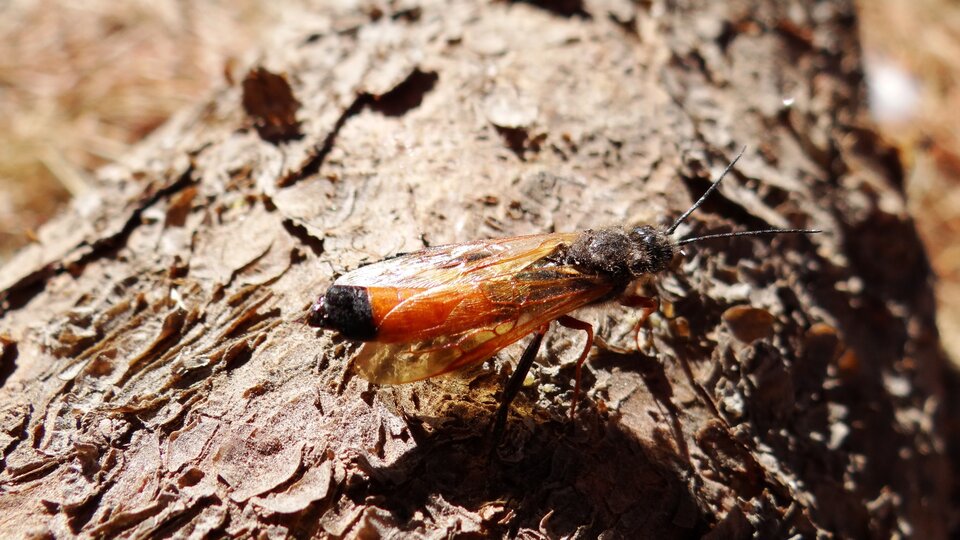
Adult sirex woodwasps have dark bodies, orange legs, cylindrical bodies, pointed abdomens, and are sexually dimorphic. Males have a metallic blue head and thorax, with an orange abdomen and front legs whereas females have blue heads and bodies and orange only on the legs. Females also have a spine or needle at the end of the abdomen.
Larval Stage
Larvae have no legs, can reach up to 30mm long, and have a visible spine towards the end of their body. They are creamy to yellowish white in color. Larval stage lasts between 10-11 months during which they feed on the fungus injected into the tree by the female and tunnel through the wood.
Pupae
Creamy white in color but adopt colors of the adult as they mature. Pupae can be found close to bark surface and typically emerge within three weeks
Eggs
Eggs are white and cylindrical. Adult females can lay between 20-450 eggs.
Photos
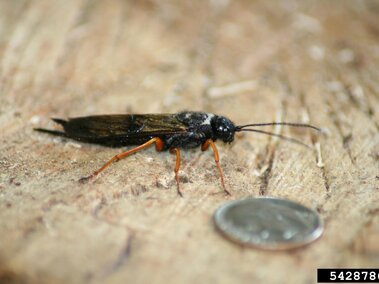
Credit: Jared Spokowsky, Indiana Department of Natural Resources, Bugwood.org
Adult female sirex woodwasp
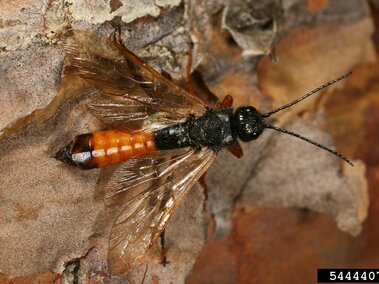
Credit: Gyorgy Csoka, Hungary Forest Research Institute, Bugwood.org
Adult male sirex woodwasp
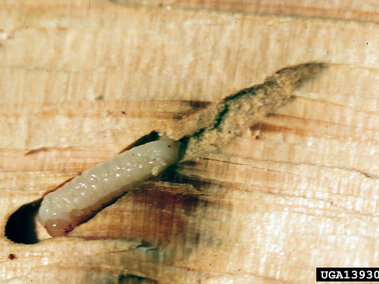
Credit: Dennis Haugen, Bugwood.org
Larval sirex woodwasp
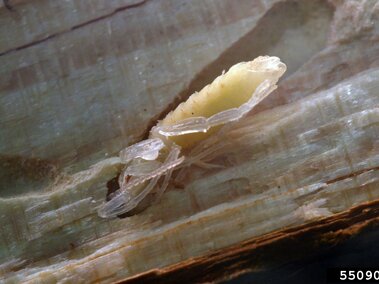
Credit: William M. Ciesla, Forest Health Management International, Bugwood.org
Sirex woodwasp pupa
What Are the Signs of Infestation?
Resin Secretion
Tree resin may ooze from areas where eggs are laid on trees, mainly concentrated at the mid-trunk area.
Foliage Damage and Death
Wilted foliage may appear yellow to reddish-brown. Heavily infested trees usually die.
Galleries
Larval galleries can be found underneath tree bark and may be packed with excrement and chewed wood.
Exit Holes
Exit holes from which adults emerge range from 3-8mm in diameter on the bark of the tree
Photos
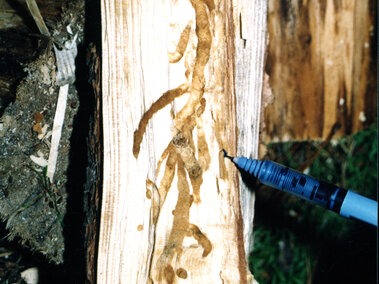
Credit: Vicky Klasmer, Instituto Nacional de Tecnologia Agropecuaria, Bugwood.org
Larval galleries
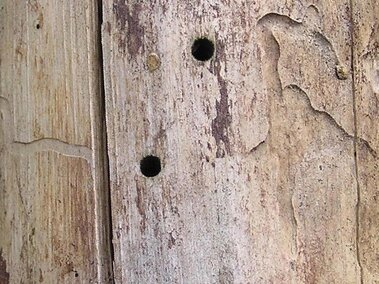
Credit: Milan Zubrik, Forest Research Institute - Slovakia, Bugwood.org
Tree with sirex woodwasp exit holes
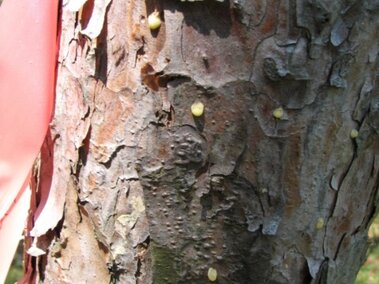
Credit: Kevin Dodds, USDA Forest Service, Bugwood.org
Resin secretion from sirex woodwasp presence
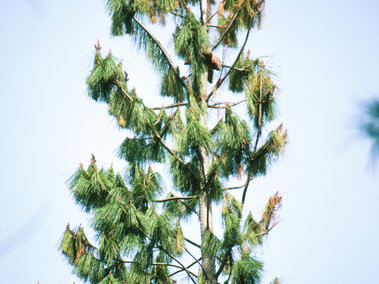
Credit: Dennis Haugen, Bugwood.org
Dead/dying foliage after mucus injection
Where Do They Live?
Sirex woodwasp can be found wherever its host species lives and is especially prevalent in areas with pine plantations. They have a limited distribution in the Northeastern United States and into Canada.
How Do They Spread?
Sirex woodwasp is spread through the movement of contaminated firewood and other wood materials by people. It was identified in the United States in 2004 and was transported through infested wood products.
What Do I Do if I Find Them?
If you find an individual or symptoms of a pine shoot beetle, report it to the Nebraska Invasive Species Council. Check out our reporting tips for more information on what to include in your report.
How Do I Control Them?
Mechanical
Proper silviculture management, such as removing weakened or dying and minimizing overcrowding can help reduce suitable habitat for sirex woodwasp. Routine surveillance for sirex woodwasp individuals and symptoms is essential.
Cultural
Do not move or transport firewood long distances and burn it where you buy it. Ensure that host species show no signs of infestation when moving them long distances for ornamental or other purposes.
Chemical
Please refer to the 2026 Guide for Weed, Disease and Insect Management in Nebraska, contact your county weed control authority, or find a certified Nebraska arborist.
References and More Information
Don't Move Firewood - Sirex Woodwasp
Massachusetts Introduced Pests Outreach Project
Mississippi Forestry Commission
National Invasive Species Information Center
Rhode Island Department of Environmental Management/Division of Agriculture
University of Maryland Extension
Washington Invasive Species Council