General Information
Species Name: Equisetum hyemale
Also Known As: Horsetail, canuela, Scouring-rush horsetail, rough horsetail
Family: Equisetaceae (Horsetails)
Growth Form: Grasslike
Life Span: Perennial
Origin: Native
Toxic: Can be toxic to livestock when consumed in large quantities, resulting in paralysis, scours, occasionally death
Noxious: No
Why Is It Problematic?
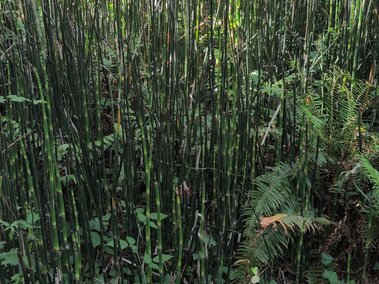
Scouring rush forms large, dense colonies, restricting the growth of other native species. Scouring horsetail can grow in a variety of conditions, including in conditions of low soil oxygen, standing water, saline water, and soil disturbance. Scouring rush is toxic to livestock in large quantities, including when cut and dried in hay. Therefore, scouring rush populations in hayfields and grasslands can be problematic. Livestock rarely consume scouring rush when it is actively growing and toxicosis typically results from contaminated hay.
What Does It Look Like?
General Characteristics
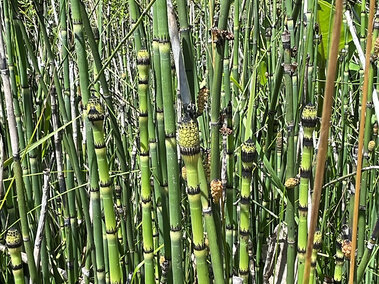
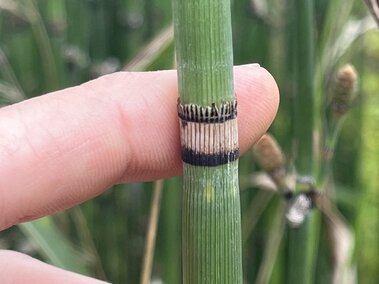
Like other horsetails, scouring rush has a distinct look with green, erect stems that have regular collar-like sheaths at the joints. They look similar to green drinking straws.
Reproductive Structure
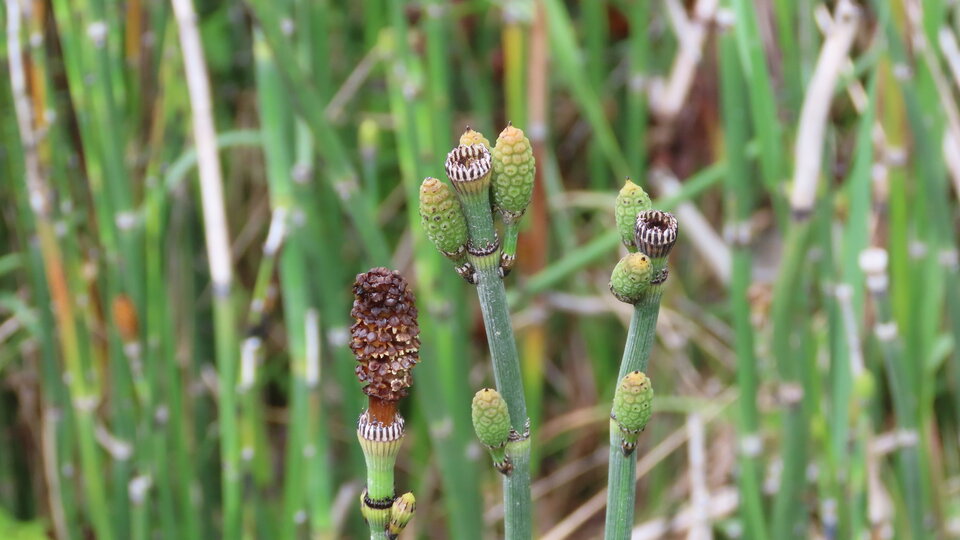
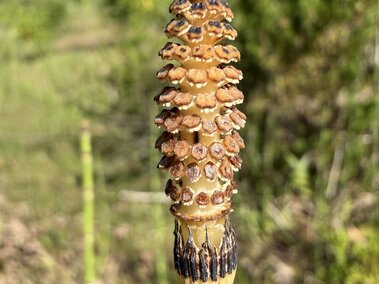
Scouring rush has a reproductive structure called a strobili. Strobili are cone-like spore-producing structures at the end of the stem. Strobili are tannish yellow to green in color.
Stems
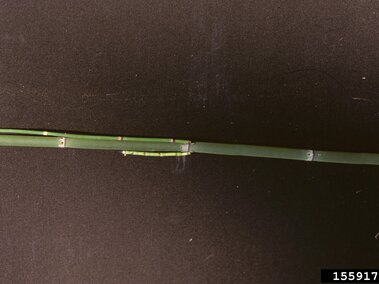
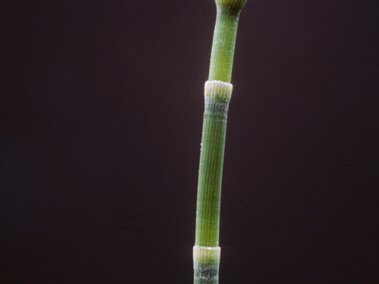
Stems are green, unbranched, hollow, and have a rough texture. Stems are slender and tall, reaching up to 1/2 inch in diameter and 4 feet in height. Stems are segmented and joined by nodes, which are black with a characteristic gray band in the center. Stems are easily pulled apart at the node and leafless.
Photos
Where Does It Grow?
Scouring rush is most often found in wet areas such as along streams, edges of lakes and ponds, and in wetlands. It is also capable of growing in wet prairies and pastures, where it can become a problem for ranchers and famers who allow livestock grazing in or hay the area. Due to its lack of leaves, scouring rush is not very tolerant of heavy shade.
How Does It Spread?
Scouring rush spreads by both spores and rhizomes. Soil disturbance and movement of contaminated soil aid in scouring rush expansion.
How Do I Control It?
Mechanical
Complete removal of strobili for 4 consecutive years can help control scouring rush. Manual removal through digging and pulling is not recommended due to scouring rush's extensive underground rhizome network which can thrive after soil disturbances.
Contact your county weed control authority to determine appropriate removal methods.
Cultural
Use only certified, weed-free hay. Do not use grazing as a management technique due to potential toxicity.
One way that invasive plant seeds and fragments can spread is in soil. Sometimes plants are planted purposefully. You can prevent the spread of invasive plants.
PlayCleanGo: Stop Invasive Species in Your Tracks
REMOVE plants, animals and mud from boots, gear, pets and vehicles.
CLEAN your gear before entering and leaving the recreation site.
STAY on designated roads and trails.
PLANT non-invasive species.
Herbicide
Please refer to the 2026 Guide for Weed, Disease and Insect Management in Nebraska and/or contact your county weed control authority.
References and More Information
Iowa State University Extension and Outreach
Missouri Department of Conservation
Nebraska Weed Control Association
Stubbendieck, J., Coffin, M., & Dunn, C. (2019). Weeds of the Great Plains. Nebraska Department of Agriculture.
Thurston County, Washington Environmental Health Division