General Information
Species Name: Gleditsia triacanthos
Also Known As: Honey-shucks, sweet locust, three-thorned-acacia, thorn tree, thorny locust, sweet-bean
Family: Fabaceae (Bean)
Growth Form: Tree
Life Span: Perennial
Flowering Dates: May-June
Origin: Native
Noxious: No
Why Is It Problematic?
Honey locust is considered a pioneer species and is one of the first species to establish in disturbed sites. This can be problematic for ranchers and farmers during land management, who may have damage to their equipment from honey locust's large thorns or whose livestock are unable to graze in area where honey locust is present due to thorns. Honey locust thorns can pose a threat to both animals and people.
Historically, honey locust was managed by wildfires, as it is not a fire-tolerant species. However, without fire management honey locust can displace native and desirable species. Additionally, managing honey locust can be difficult, as cutting or mowing can increase sprouts. In areas to which it is non-native honey locust has proven to be a highly aggressive invaders as it is tolerant of a variety of soil and environmental conditions.
What Does It Look Like?
General Characteristics
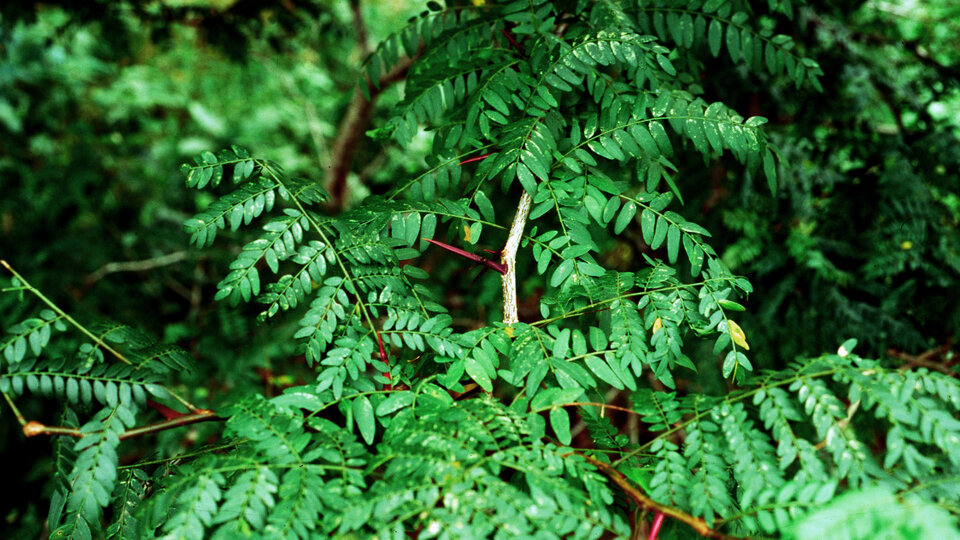
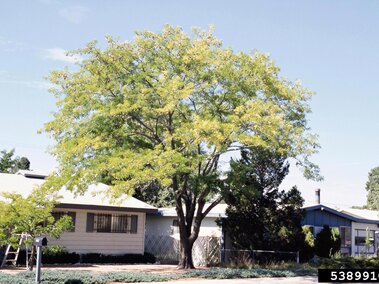
Honey locust can grow up to 80 feet tall and has a broad, flat-topped crown that allows moderate light permeation.
Flowers
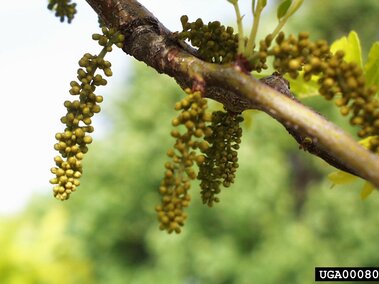
Flowers are small and can be greenish-white or yellow. They will appear after leaves open and grow in clusters. There are separate male and female flowers.
Leaves
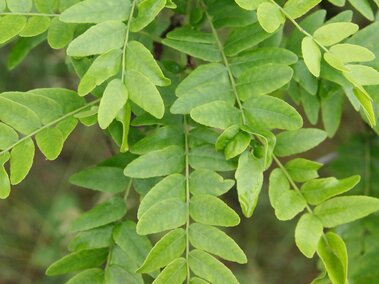
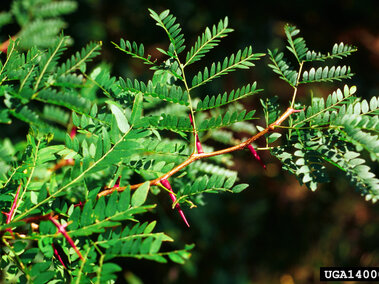
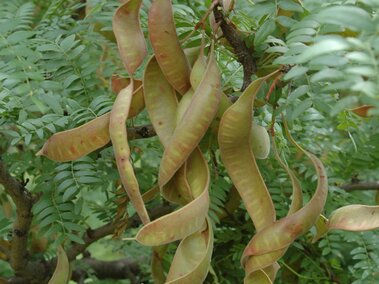
Leaves are alternately arranged about stems and comprised of 15-30 leaflets. Each leaflet is approximately 1-2 inches long and are broadest near the base of the leaf. Leaflet margins are either untoothed or may have very small, rounded teeth. The topside of the leaf appears shiny whereas the underside of the leaf is pale and may have small hairs.
Bark/Stems
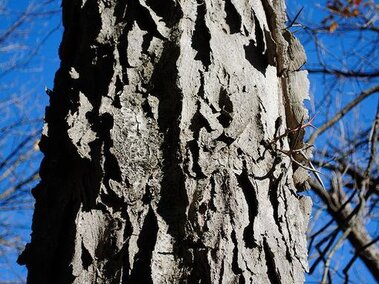
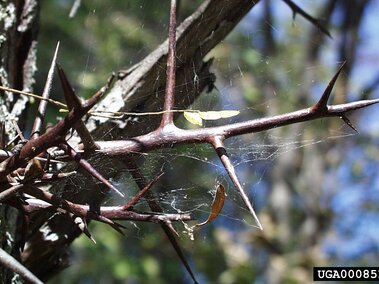
Trunk bark is grayish brown or black, with older trees possessing deep, narrow grooves that separate into scaly ridges. Twigs are greenish to reddish brown and shiny. They often have a zigzag appearance. Thorns are rigid, sharp, straight, shiny, purplish, and reach up to 12 inches in length. Thorns can be found on branches and twigs.
Seeds
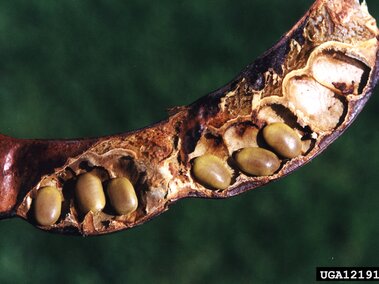
Seeds are brown, oval, and reach about 1/2 inch long. 6 to 27 seeds may be contained in a dark brown, leathery seed pod. Pods are narrow, flat, twist with age, and can reach 6-18 inches long.
Photos
Where Does It Grow?
Honey locust is native to the Midwest United States, including Nebraska, and has become naturalized in some parts of the Eastern United States. It is considered a pioneer species and is one of the first species to establish after disturbances, such as fire or flooding. It is well adapted to a variety of soil and environmental conditions, establishing in woodlands, rocky areas, river floodplains, pastures and rangelands, and along fence rows. While it can be found in forested areas, it is not usually a primary component of forest biomass. It is shade-tolerant but is not fire-tolerant. Honey locust can occur in stands or as a solitary tree.
Honey locust becomes problematic when it invades managed grass, pasture, and crop areas. Additionally, it can displace native vegetation in natural ecosystems after disturbances if no fire even occurs to help manage honey locust populations.
How Does It Spread?
Honey locust spreads via seed. Seed can be distributed by wildlife, livestock, and birds which favor the fruit of honey locust. Honey locust seeds can also be spread by attaching to equipment, clothing, shoes, and when intentionally planted by people. Honey locust also produces from stump and root sprouts.
Honey locusts produce seed from 10-100 years of age. Seed production occurs every year, but large crops will be produced every 2 years. Honey locust seeds can remain viable for several years.
How Do I Control It?
Mechanical
Prescribed burning is an effective control strategy for honey locust. Saplings and small trees can be removed by hand-pulling or digging. Cutting honey locust at the stump without removing the stump and roots can result in aggressive resprouting of the plant. Take care when handling honey locust trees to avoid sharp, hazardous thorns.
Contact your county weed control authority to determine appropriate removal methods.
Cultural
Instead of honey locust, consider planting an alternative native tree for landscaping purposes. Planting honey locust for landscape purposes is generally not recommended due to its invasive tendencies and large, sharp, hazardous thorns.
One way that invasive plant seeds and fragments can spread is in soil. Sometimes plants are planted purposefully. You can prevent the spread of invasive plants.
PlayCleanGo: Stop Invasive Species in Your Tracks
REMOVE plants, animals and mud from boots, gear, pets and vehicles.
CLEAN your gear before entering and leaving the recreation site.
STAY on designated roads and trails.
PLANT non-invasive species.
Herbicide
Please refer to the 2026 Guide for Weed, Disease and Insect Management in Nebraska and/or contact your county weed control authority.
References and More Information
Iowa State University Extension and Outreach
Minnesota Department of Natural Resources
Missouri Department of Conservation
Native Plant Society of Texas Collin County Chapter
Nebraska Weed Control Association
North Carolina State University Extension Gardener
USDA NRCS East Texas Plant Materials Center Plant Fact Sheet
USDA NRCS National Plant Data Center & the Biota of North America Program Plant Fact Sheet
University of Minnesota Urban Forestry Outreach and Research
Utah State University TreeBrowser Extension