General Information
Species Name: Clematis terniflora
Also Known As: Sweetautumn clematis, leatherleaf clematis, yamleaf clematis, Japanese clematis
Family: Ranunculaceae (Buttercup)
Growth Form: Vine
Life Span: Perennial
Flowering Dates: July-October
Origin: Asia
Toxic: Can cause severe gastrointestinal ulcerations upon ingestion in humans, domestic pets, livestock, and horses
Noxious: No
Why Is It Invasive?
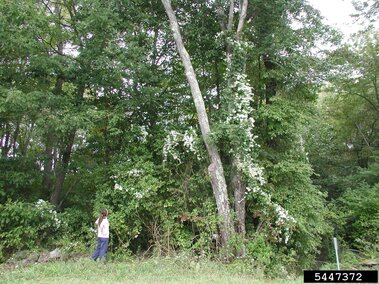
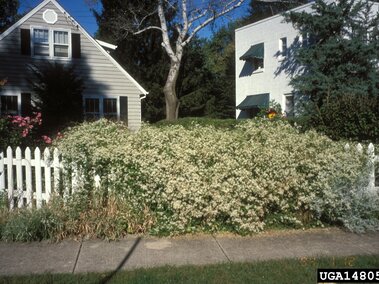
Sweet autumn virgin's bower is a highly invasive woody vine that can establish in shade and climb on structures. It grows quickly and forms dense mats that outcompete and cover plants and trees and suppress germination of seeds on the ground. It is also toxic upon ingestion in multiple species and causes severe ulcerations, but is usually not fatal due to its bitter taste and resulting mouth pain, discouraging the individual from continuing to ingest it.
What Does It Look Like?
Flowers
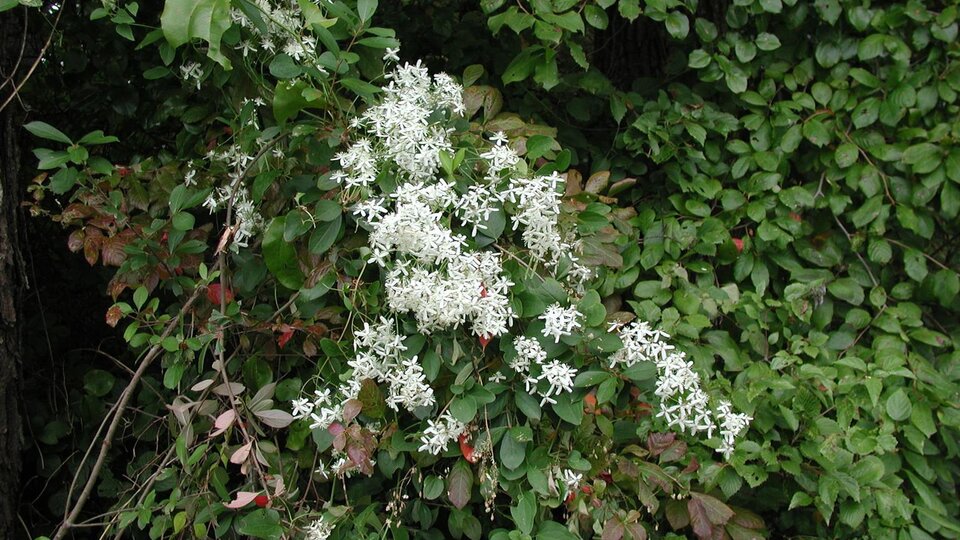
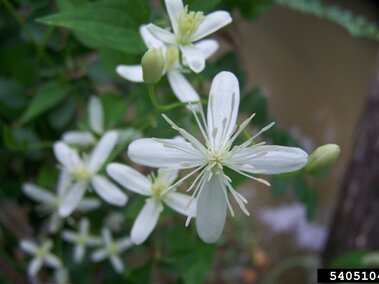
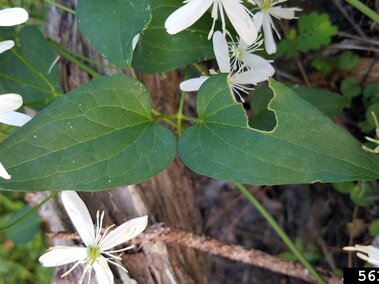
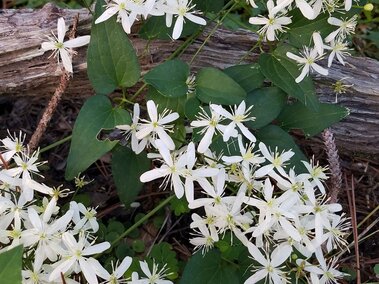
Flowers are white with 4 narrow petals and long spreading stamens. Flowers are sweet scented.
Leaves
Leaves are oppositely arranged and consist of 3-5 leaflets which are narrowly triangular. Leaflets have margins without teeth and are smooth without hairs. The topside of the leaf is medium green and the underside is paler green.
Stem
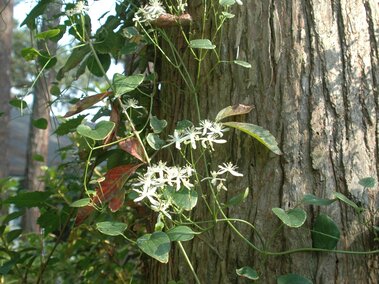
Stems are scrambling or climbing and become woody with maturity. Stems may have small hairs. Young stems are green and mature into a grayish-brown with long splits and shredding. The main stem may reach up to 10cm in diameter.
Seeds
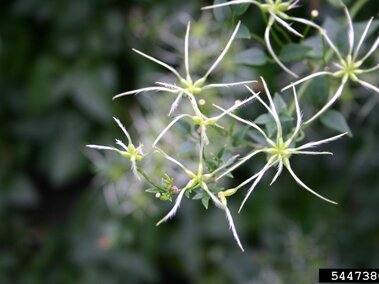
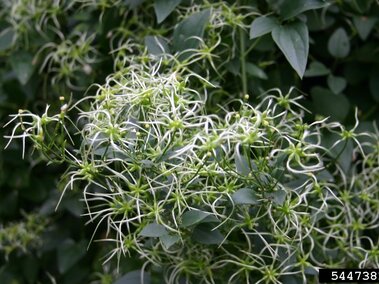
Seeds are small and contained in small fruits which are clustered in groups of 5-6. Fruits are ovoid, flattened, light green, and have a long white tail at the tip.
Photos
Where Does It Grow?
Sweet autumn virgin's bower will grow in shaded areas, climbing to sunlight, and grows best in well drained soils. It can be found in forests, roadsides, and along creek and riverbeds and can climb on structures and other plants and trees. It is primarily found in the Southeastern United States.
How Does It Spread?
Sweet autumn virgin's bower spreads through underground runners and seed. A single plant can grow up to 30 feet high and wide. Birds and wildlife disperse seeds after eating the plant's star-shaped fruit. Sweet autumn virgin's bower was initially introduced to the United States for use as an ornamental plant but escaped cultivation.
How Do I Control It?
Mechanical
Small infestations can be hand pulled and care should be taken to remove the plant's roots. If fruit are present, bag and dispose of them in a waste receptacle and take care not to spread fruits and seeds. Cut climbing vines near the ground to kill the upper portion of the vine. Cutting and manual removal should be followed by vigilant monitoring and be repeated as necessary.
Please contact your county weed control authority to determine appropriate removal methods.
Cultural
Do not plant sweet autumn virgin's bower for any purpose, including ornamental. Consider planting native woodbine (Clematis virginiana) instead. Do not allow livestock to graze in areas where sweet autumn virgin's bower is present due to potential toxicity.
One way that invasive plant seeds and fragments can spread is in soil. Sometimes plants are planted purposefully. You can prevent the spread of invasive plants.
PlayCleanGo: Stop Invasive Species in Your Tracks
REMOVE plants, animals and mud from boots, gear, pets and vehicles.
CLEAN your gear before entering and leaving the recreation site.
STAY on designated roads and trails.
PLANT non-invasive species.
Herbicide
Please refer to the 2026 Guide for Weed, Disease and Insect Management in Nebraska and/or contact your county weed control authority.
References and More Information
Invasive Plant Atlas of the United States
Nebraska Weed Control Association
North Carolina Botanical Garden
North Carolina State University Extension Gardener
Oregon State University Department of Horticulture
Stubbendieck, J., Coffin, M., & Dunn, C. (2019). Weeds of the Great Plains. Nebraska Department of Agriculture.
Tennessee Invasive Plant Council
University of Florida Center for Aquatic and Invasive Plants