General Information
Species Name: Potentilla recta
Family: Rosaceae (Rose)
Growth Form: Forb
Life Span: Perennial
Flowering Dates: May-July
Origin: Europe
Noxious: No
Why Is It Invasive?
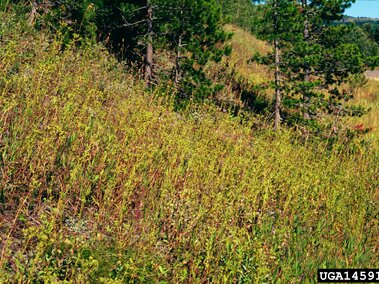
Sulfur cinquefoil forms dense monocultures and outcompetes native plants and desirable forage. It can grow in rangeland and pastures and is not palatable forage for most wildlife and livestock.
What Does It Look Like?
Flowers
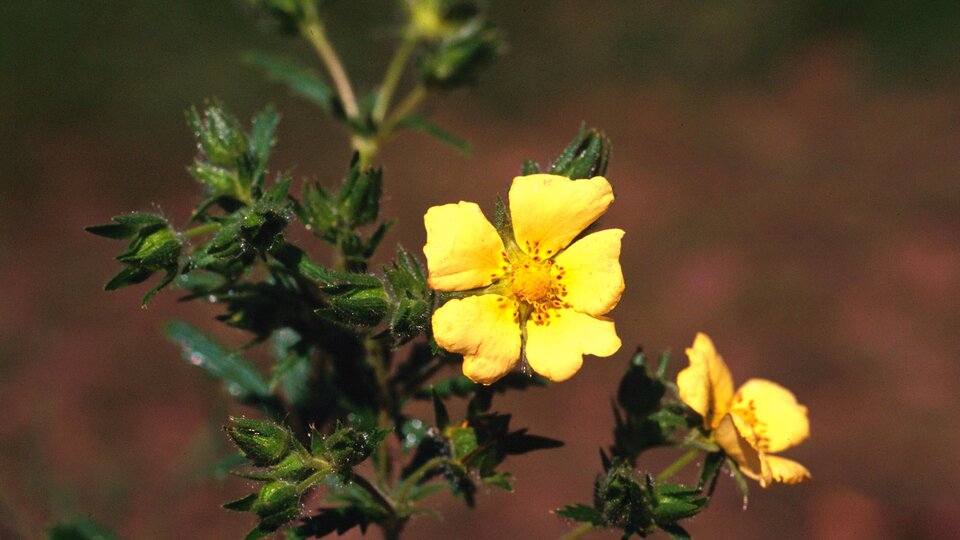
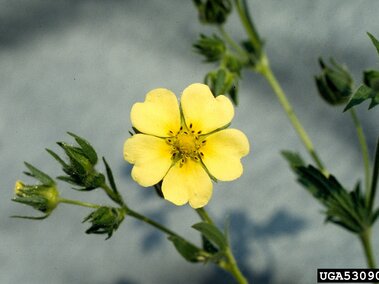
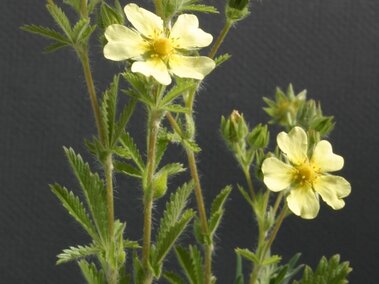
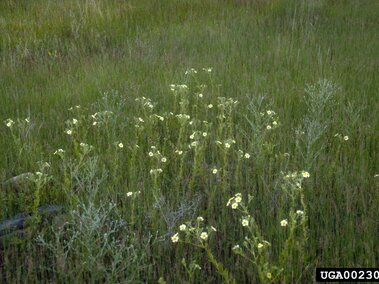
Flowers have bright yellow centers and 5 white, heart-shaped petals. One stem can support anywhere from 1 to 60 flowers.
Leaves
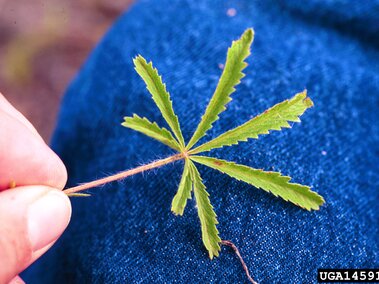
Leaves are alternately arranged on the stem and composed of 5 or 7 leaflets. Leaflets are narrow and have teeth margins. The middle leaflet is the longest and the underside of leaves is paler than the topside.
Stem
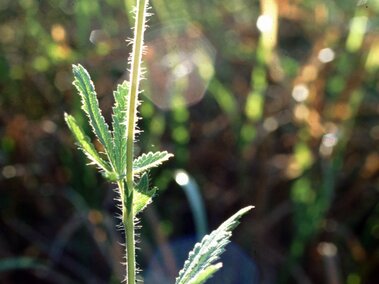
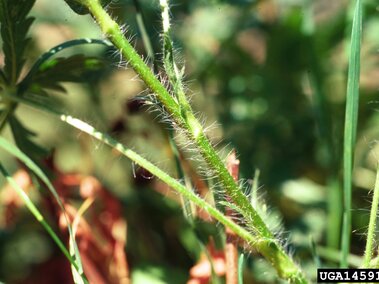
Stems are upright and there may be up to 5 branches per plant. Leaves are slender and have small hairs.
Seeds
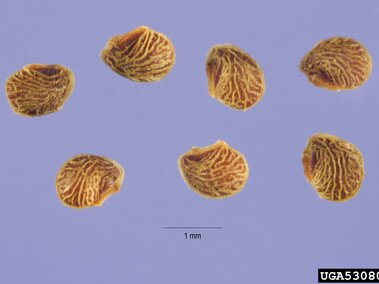
Seeds are reddish-brown to brown. Each seed is contained in a kidney-shaped fruit that is dark brown to reddish purple and ribbed.
Photos
Where Does It Grow?
Sulfur cinquefoil invades grasslands, forests, pastures, meadows, and rangelands. It is widespread throughout North America.
How Does It Spread?
Sulfur cinquefoil primarily reproduces by seed, which can be transported by natural or human vectors. Seeds can remain viable in soil for up to 4 years. It can also reproduce vegetatively through spreading roots which can sprout entire new plants.
How Do I Control It?
Mechanical
Manual removal is feasible for small populations and early infestations. Care should be taken to remove as much of the root as possible and the entire taproot to prevent resprouting. Mowing is not an effective control method.
Please contact your county weed control authority to determine appropriate removal methods.
Cultural
Purchase certified, weed-free hay for livestock and other purposes.
One way that invasive plant seeds and fragments can spread is in soil. Sometimes plants are planted purposefully. You can prevent the spread of invasive plants.
PlayCleanGo: Stop Invasive Species in Your Tracks
REMOVE plants, animals and mud from boots, gear, pets and vehicles.
CLEAN your gear before entering and leaving the recreation site.
STAY on designated roads and trails.
PLANT non-invasive species.
Herbicide
Please refer to the 2026 Guide for Weed, Disease and Insect Management in Nebraska and/or contact your county weed control authority.
References and More Information
Bureau of Indian Affairs Navajo Region
Colorado Department of Agriculture
Missouri Department of Conservation
Nebraska Weed Control Association
Stubbendieck, J., Coffin, M., & Dunn, C. (2019). Weeds of the Great Plains. Nebraska Department of Agriculture.
Washington State Noxious Weed Control Board