General Information
Species Name: Bromus tectorum
Also Known As: bronco grass, downy brome, downy chess, drooping brome, early chess, military chess, militarygrass, thatch bromegrass
Family: Poaceae (Grass)
Growth Form: Grass
Life Span: Winter annual
Flowering Dates: June-August
Origin: Europe
Toxic: No, but the awned seeds may cause sores in the mouths and eyes of grazing animals and reduce the value of wool. They can also become embedded, ingested, or inhaled by other animals, which can cause injury or serious health issues if they become infected or migrate into the lungs or other internal organs.
Noxious: No
Why Is It Invasive?
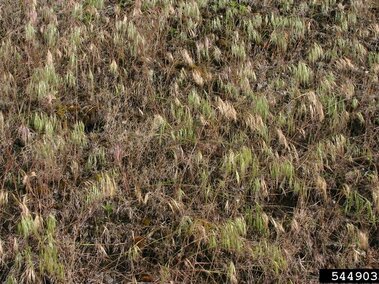
Cheatgrass can draw down soil moisture and nutrients to very low levels, making it difficult for other species to compete. An increased cycle of fires favors annual species at the expense of many perennials. Due to its tendency to mature early and then dry out, it gains a competitive advantage through the promotion of fire. It is an agricultural, nursery and orchard pest.
What Does It Look Like?
General Characteristics
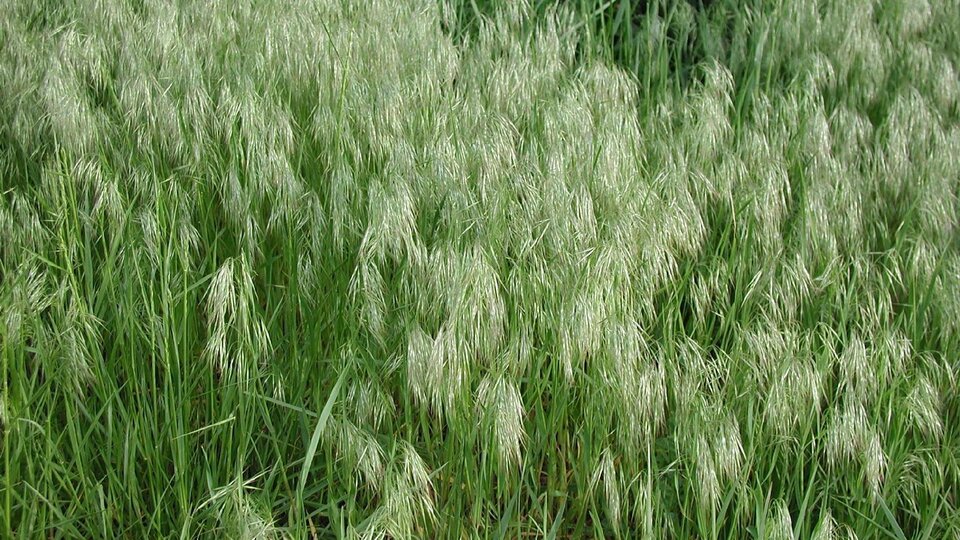
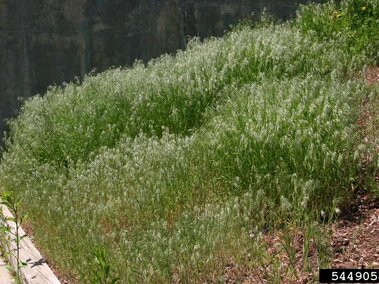
Cheatgrass is an erect-stemmed annual grass that grows to about 8-25 in. (20-70 cm) in height.
Flowers
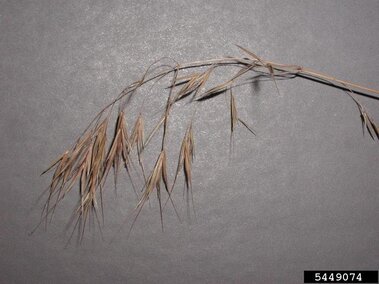
Flowering head is a loose panicle 2 to 8 inches long, nodding to one side, the branches arching, drooping at the tips, the lower branches with up to 8 spikelets (flower clusters) per branch and the upper often with only 1 or 2. Spikelets are stalked, lance-elliptic in outline, not much flattened, 10 to 25+ mm (to 1+ inch) long, with 3 to 8 florets. One or more sterile florets may be at the tip.
At the base of a spikelet is a pair of bracts (glumes), both hairless to variously hairy and pointed at the tip, the lower glume 6 to 11 mm long and 1-veined, the upper glume 6 to 13 mm long and 3-veined. Surrounding a floret is a pair of bracts (lemma and palea). Lemmas are lance-elliptic, 8 to 13 mm long, usually short-hairy sometimes with scattered long hairs, 5 to 7-veined, notched at the tip forming 2 teeth with a straight awn 10 to 30 mm (to 1+ inch) long arising between the teeth. The palea is shorter than the lemma, elliptic, 2-veined, hairless to sparsely short-hairy on the surface with sparse, long hairs along the veins. Sterile florets are like the fertile but underdeveloped.
Leaves
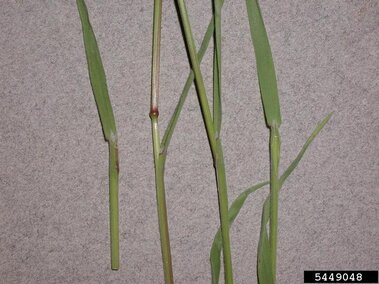
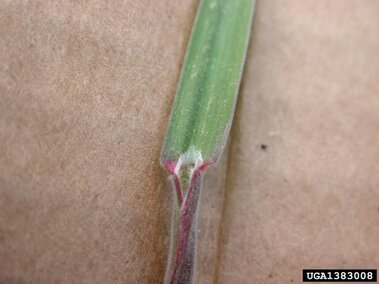
Leaf blades are spreading to ascending, flat, 2 to 6 inches long, 1 to 6 mm (to ¼ inch) wide, both surfaces densely covered in short, soft hairs and may have a few long, spreading or crinkly hairs. Sheath edges are fused for most of their length (a closed sheath), covered in short, soft hairs and may have a few long hairs near the tip. The ligule (membrane where the leaf joins the sheath) is membranous, 2 to 5 mm long, jagged along the top edge and lacks a fringe of hairs. Nodes are hairy or not.
Stems
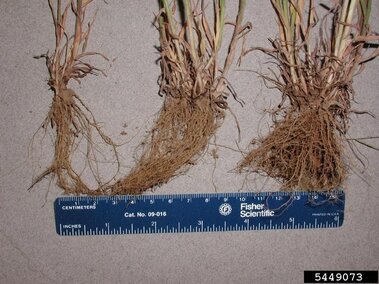
Stems are hairless or hairy just at the nodes, several to many from the base forming clumps, erect to ascending or spreading from the base and rising at a lower node (geniculate).
Seeds
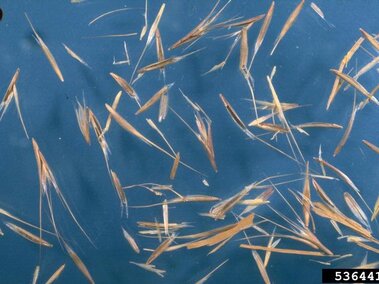
Spikelets frequently turn purple as they mature, the florets eventually drying to light brown, the awns spreading out away from the spikelet as they dry, and each floret dropping off individually leaving the glumes persisting on the stalk. Grains are somewhat flattened, elliptic, up to 9 mm long, and have a bundle of white hairs at the tip.
Photos

Where Does It Grow?
It is found throughout the Great Plains in heavily grazed pastures, fields, disturbed sites, roadsides, and waste areas.
How Does It Spread?
Cheatgrass was introduced to the U.S. in the mid- to late-1800's as a contaminant in seed and straw. It produces a dense root mat in early spring, stealing water and soil resources from other spring plants (hence the “cheat”). It invades both high quality and disturbed areas, crowding out native species in natural areas, contaminating agricultural fields, and is especially problematic in the western US. It likes fire and can explode after a burn.
How Do I Control It?
Mechanical
Contact your county weed control authority to determine appropriate removal methods.
Cultural
One way that invasive plant seeds and fragments can spread is in soil. Sometimes plants are planted purposefully. You can prevent the spread of invasive plants.
PlayCleanGo: Stop Invasive Species in Your Tracks
REMOVE plants, animals and mud from boots, gear, pets and vehicles.
CLEAN your gear before entering and leaving the recreation site.
STAY on designated roads and trails.
PLANT non-invasive species.
Herbicide
Please refer to the 2025 Guide for Weed, Disease and Insect Management in Nebraska and/or contact your county weed control authority.
References and More Information
California Invasive Plant Council
Center for Invasive Species and Ecosystem Health
Dunn, C. D., Stephenson, M. B., and Stubbendieck, J. (2016). Common Grasses of Nebraska. University of Nebraska-Lincoln Extension.
Fire Effects Information System
Global Invasive Species Database
National Invasive Species Information Center
Natural Resources Conservation Service
Nebraska County Designated Noxious Weeds
Nebraska Department of Agriculture
Nebraska Weed Control Association
Nebraska Weed Free Forage Program
North Dakota Department of Agriculture
Stubbendieck, J., Coffin, M., & Dunn, C. (2019). Weeds of the Great Plains. Nebraska Department of Agriculture.